Molecular Orbital Theory
Practice: Start 10 random questions on this lesson · Pick your own set
Lewis structures and hybrid orbitals can’t explain everything. The best-known failure is oxygen: its Lewis structure, O=O, has every electron paired, but liquid oxygen sticks to a magnet, which means it has unpaired electrons. Molecular orbital (MO) theory explains this.
1. Molecular orbitals (9.7)
In MO theory, electrons don’t belong to one atom or one bond. They occupy molecular orbitals that spread over the whole molecule. Like atomic orbitals, each MO holds at most two electrons with opposite spins.
When two atomic orbitals combine, they always make two molecular orbitals:
| Bonding MO | Antibonding MO (marked with *) | |
|---|---|---|
| Energy | lower than the atomic orbitals | higher than the atomic orbitals |
| Electron density | concentrated between the nuclei | a node between the nuclei, density pushed to the outsides |
| Effect of electrons in it | holds the atoms together | pushes them apart |
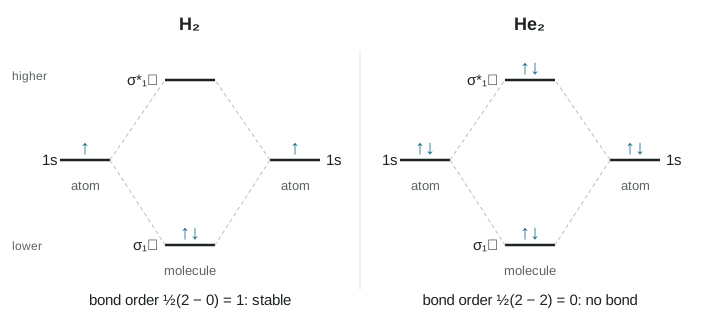
For two 1s orbitals, these are σ_1s and σ_1s^∗.
Bond order
bond order = 1/2 (bonding electrons − antibonding electrons)A bond order of 1, 2, or 3 matches a single, double, or triple bond. A bond order of 0 means the molecule isn’t stable. Fractional bond orders are allowed.
| Species | Configuration | Bond order | Exists? |
|---|---|---|---|
| H₂ | (σ_1s)² | 1/2(2 − 0) = 1 | yes |
| H₂⁺ | (σ_1s)¹ | 1/2(1 − 0) = 1/2 | yes, a weak bond |
| He₂⁺ | (σ_1s)²(σ_1s^∗)¹ | 1/2(2 − 1) = 1/2 | yes, a weak bond |
| He₂ | (σ_1s)²(σ_1s^∗)² | 1/2(2 − 2) = 0 | no |
He₂ doesn’t form because the antibonding electrons cancel the bonding ones.
2. Period 2 diatomic molecules (9.8)
For Li₂ through Ne₂, only the valence orbitals matter (the 1s electrons fill both σ₁ₛ and σ*₁ₛ and cancel out). From the 2s orbitals you get σ₂ₛ and σ*₂ₛ. From the six 2p orbitals you get six MOs:
- one σ₂ₚ and one σ*₂ₚ (from the 2p orbitals pointing at each other), and
- two π₂ₚ and two π*₂ₚ (from the 2p orbitals side by side; each pair has equal energy).
The order switches after N₂
For O₂, F₂, and Ne₂, σ₂ₚ is lower in energy than π₂ₚ. For B₂, C₂, and N₂, the 2s and 2p orbitals are close enough in energy to interact, which pushes σ₂ₚ above π₂ₚ.
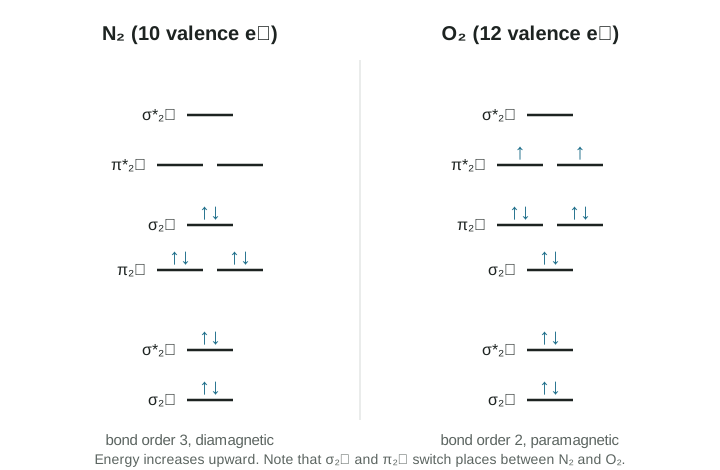
Fill the diagram like atomic orbitals: lowest energy first, two per orbital, and Hund’s rule for the pairs of π orbitals (one electron in each before pairing).
| Molecule | Valence e⁻ | Configuration (valence) | Bond order | Unpaired e⁻ |
|---|---|---|---|---|
| Li₂ | 2 | (σ_2s)² | 1 | 0 |
| Be₂ | 4 | (σ_2s)²(σ_2s^∗)² | 0 | (doesn’t form) |
| B₂ | 6 | …(π_2p)² | 1 | 2 |
| C₂ | 8 | …(π_2p)⁴ | 2 | 0 |
| N₂ | 10 | …(π_2p)⁴(σ_2p)² | 3 | 0 |
| O₂ | 12 | …(σ_2p)²(π_2p)⁴(π_2p^∗)² | 2 | 2 |
| F₂ | 14 | …(σ_2p)²(π_2p)⁴(π_2p^∗)⁴ | 1 | 0 |
| Ne₂ | 16 | all bonding and antibonding filled | 0 | (doesn’t form) |
As the bond order goes up from B₂ to N₂, the bonds get stronger and shorter. From N₂ to F₂ the bond order drops, and the bonds get weaker and longer. N₂, with bond order 3, has one of the strongest bonds known.
Paramagnetism
- Paramagnetic: has unpaired electrons, so it’s attracted into a magnetic field. B₂ and O₂.
- Diamagnetic: all electrons paired, so it’s weakly pushed out of a magnetic field. C₂, N₂, F₂.
O₂ has two unpaired electrons, one in each π*₂ₚ orbital. MO theory predicts this and the double bond (bond order 2) at the same time, which is something the Lewis structure can’t do.
Molecules made of two different atoms
When the two atoms are different but close neighbors in period 2 (NO, CO, CN⁻), the same diagram works. Count the total valence electrons and fill from the bottom:
- NO has 5 + 6 = 11 valence electrons, one more than N₂. The extra one goes alone into a π*₂ₚ orbital, so the bond order is 1/2(8 − 3) = 2.5 and NO is paramagnetic.
- CO and CN⁻ each have 10, the same as N₂ (they’re isoelectronic with it), so each has bond order 3 and is diamagnetic.
Worked example: O₂⁺, O₂⁻, and O₂²⁻
Start from O₂ (12 valence electrons, bond order 2, two electrons in π*₂ₚ) and change only the π*₂ₚ electrons:
| Species | Valence e⁻ | π*₂ₚ electrons | Bond order | Paramagnetic? |
|---|---|---|---|---|
| O₂⁺ | 11 | 1 | 1/2(8 − 3) = 2.5 | yes |
| O₂ | 12 | 2 | 1/2(8 − 4) = 2 | yes |
| O₂⁻ | 13 | 3 | 1/2(8 − 5) = 1.5 | yes |
| O₂²⁻ | 14 | 4 | 1/2(8 − 6) = 1 | no |
Bonding electrons stay at 8 (σ₂ₛ², σ₂ₚ², π₂ₚ⁴). Removing an antibonding electron raises the bond order, so O₂⁺ has the shortest, strongest bond of the four and O₂²⁻ the longest and weakest.