Orbital Overlap, Hybrid Orbitals, and Sigma and Pi Bonds
Practice: Start 10 random questions on this lesson · Pick your own set
On this page 4 sections
VSEPR predicts shapes but doesn’t say how the electrons actually form bonds. Valence-bond theory connects bonds to the atomic orbitals from Chapter 6.
1. Bonds form by orbital overlap (9.4)
A covalent bond forms when an orbital on one atom overlaps an orbital on another, and the two electrons (one from each atom, with opposite spins) share the overlap region between the nuclei. Both nuclei attract that shared pair.
How close do the atoms get? The graph shows the potential energy of two H atoms as they approach:
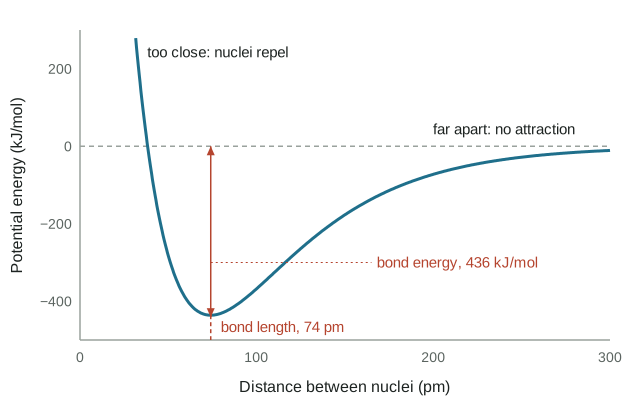
- Far apart, the atoms don’t interact: energy is zero.
- Closer, the orbitals overlap and each nucleus attracts the other’s electron, so the energy drops.
- Too close, the two positive nuclei (and the electrons) repel, and the energy shoots up.
- The minimum is the most stable distance. Its distance is the bond length (74 pm for H₂), and its depth below zero is the bond energy (436 kJ/mol), the energy needed to pull the atoms apart.
2. Hybrid orbitals (9.5)
Unhybridized atomic orbitals can’t explain most shapes. Carbon’s valence orbitals are one 2s and three 2p orbitals at 90° to each other, yet methane’s four C–H bonds are identical and 109.5° apart.
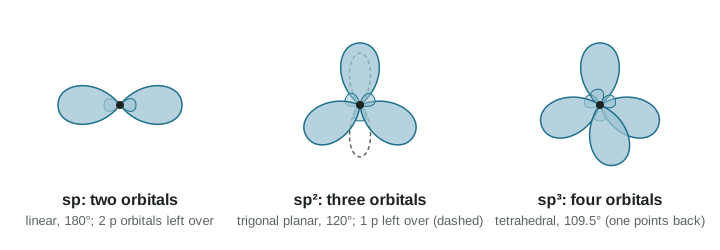
The fix: the atom mixes some of its valence orbitals to make an equal number of new, identical hybrid orbitals that point toward the electron domains. Count the electron domains on the atom and you have the hybridization: each domain (bond or lone pair, with a multiple bond counting once) needs one hybrid orbital.
2 electron domains
sp
1 s + 1 p → 2 sp
linear, 180°
2 p left over: up to 2 π bonds
C in CO₂ and HC≡CH, Be in BeF₂
Name and angle on the AP exam
3 electron domains
sp²
1 s + 2 p → 3 sp²
trigonal planar, 120°
1 p left over: up to 1 π bond
C in C₂H₄ and H₂CO, B in BF₃
Name and angle on the AP exam
4 electron domains
sp³
1 s + 3 p → 4 sp³
tetrahedral, 109.5°
no p left over: no π bonds
C in CH₄, N in NH₃, O in H₂O
Name and angle on the AP exam
5 electron domains
sp³d
1 s + 3 p + 1 d → 5 sp³d
trigonal bipyramidal, 90°, 120°, 180°
P in PCl₅, S in SF₄
Class only
6 electron domains
sp³d²
1 s + 3 p + 2 d → 6 sp³d²
octahedral, 90°, 180°
S in SF₆, Xe in XeF₄
Class only
Questions about hybridization ask about central or interior atoms (any atom bonded to two or more others). An outer atom such as an F in BF₃ isn’t usually given a hybridization.
What happens, step by step
Pick a molecule, then step through it. The box diagram under the model shows the same thing as energy levels: the highlighted column matches the step you’re on.
CH₄, step 1: Carbon's valence orbitals: one 2s (holding 2 electrons) and three 2p at 90° to each other, only two of them with an electron. Orbitals at 90° can't give four identical bonds at 109.5°.
- s orbital
- p orbital
- hybrid orbital
- partner atom's orbital
- σ bond
- electron
Ground state
Promote one 2s electron
sp³ hybridized
What happens at each step (the step buttons above the model):
- Atomic orbitals. The central atom starts with one 2s and three 2p orbitals. The 2p orbitals point along x, y, and z, at 90° to each other.
- Promote (only CH₄, BF₃, and BeF₂). Be, B, and C have fewer unpaired electrons than bonds to make, so one 2s electron moves up into an empty 2p orbital. That costs energy, which forming the extra bonds pays back. N and O already have enough unpaired electrons, so NH₃ and H₂O skip this step.
- Mix. The 2s and some of the 2p orbitals combine into the same number of hybrid orbitals. Each hybrid has one big lobe (where the bond or lone pair goes) and a small lobe behind it. They’re all identical and point as far apart as possible: the VSEPR geometry. The electrons go one per hybrid first; any left over go one each into leftover p orbitals (those form π bonds, section 3), and any still left pair up in hybrids as lone pairs (N has one, O has two). B and Be run out first, so in BF₃ and BeF₂ the leftover p orbitals stay empty.
- Form σ bonds. Each half-filled hybrid overlaps a half-filled orbital on another atom, head-on.
3. Sigma and pi bonds (9.6)
There are two ways orbitals can overlap:
- Sigma (σ) bond: head-on overlap, so the shared electrons sit on the line between the two nuclei. Made from hybrid orbitals, s orbitals, or p orbitals pointing at each other. More overlap, so it’s the stronger of the two.
- Pi (π) bond: side-by-side overlap of two parallel p orbitals, so the electrons sit above and below that line, with none on it. Less overlap, so it’s weaker.
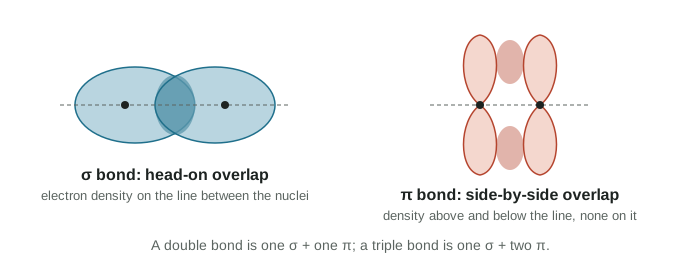
Every bond between two atoms has exactly one σ bond. Extra pairs are π bonds:
| Bond | σ | π |
|---|---|---|
| single | 1 | 0 |
| double | 1 | 1 |
| triple | 1 | 2 |
See them form
Each example starts with the hybrids and leftover p orbitals, then makes the σ bonds (green sticks), then the π bonds (pink clouds). Turn the model edge-on to see that a π bond is two lobes, one on each side of the bond axis.
C₂H₄, step 1: Each carbon is sp²: three hybrids in the plane (toward the other C and two H atoms), plus one unhybridized p orbital standing straight up and down, with one electron.
- p orbital
- hybrid orbital
- partner atom's orbital
- σ bond
- π electrons
- electron
Ground state
Promote one 2s electron
sp² hybridized
- Ethylene, H₂C = CH₂: each carbon is sp². The sp² orbitals make the C–C σ bond and four C–H σ bonds, all in one plane. The leftover p orbitals overlap side by side above and below that plane: the π bond. Twisting one end would pull the p orbitals apart and break the π bond, so there is no rotation around a double bond.
- Acetylene, HC ≡ CH: each carbon is sp, with two leftover p orbitals at right angles. They make two π bonds in perpendicular planes, so the triple bond is one σ and two π.
- Formaldehyde, H₂CO: C and O are both sp². The C=O is one σ and one π, and O’s two lone pairs sit in its other two sp² hybrids.
- Carbon dioxide: C is sp, each O is sp². The two π bonds are at right angles to each other, one to each O.
Worked example: count σ and π bonds and name hybridizations
Acrylonitrile is H₂C = CH − C ≡ N (three H atoms in all).
| Bonds | σ | π |
|---|---|---|
| 3 C–H | 3 | 0 |
| C=C | 1 | 1 |
| C–C | 1 | 0 |
| C≡N | 1 | 2 |
| Total | 6 | 3 |
Hybridization from domain counts:
- the CH₂ carbon: 3 domains (two C–H, one C=C), sp²
- the CH carbon: 3 domains (C–H, C=C, C–C), sp²
- the C of C≡N: 2 domains (C–C, C≡N), sp
4. Delocalized π bonding
In a molecule with resonance structures, the π electrons aren’t stuck between two atoms. In the carbonate ion, CO₃²⁻, C is sp² with one leftover p orbital, and each O has a parallel p orbital too. All four overlap side by side, so the π electrons spread over the whole ion. These are delocalized π bonds, and they’re the orbital picture of resonance: one resonance structure shows only one place the π bond could be; the real ion has it spread over all of them.
C₆H₆, step 1: One resonance structure puts three π bonds in fixed places (alternating with single bonds). If that were the real molecule, the double bonds would be shorter than the single bonds. They aren't: all six C–C bonds are the same length.
- p orbital
- σ bond
- π electrons
- electron
Benzene is the best-known example. All six carbons are sp², so there’s a p orbital on each one pointing above and below the flat ring. The six π electrons spread around the whole ring, which is why all six C–C bonds are identical and why benzene is often drawn as a hexagon with a circle inside.