Jaya's Notes: Chapter 9
A classmate's notes, with the wording kept as close to the original as possible. Where something needed fixing, there's a Correction box right below it. See the original pages.
Practice: Start 10 random questions from Chapter 9 · Pick your own set
On this page 5 sections
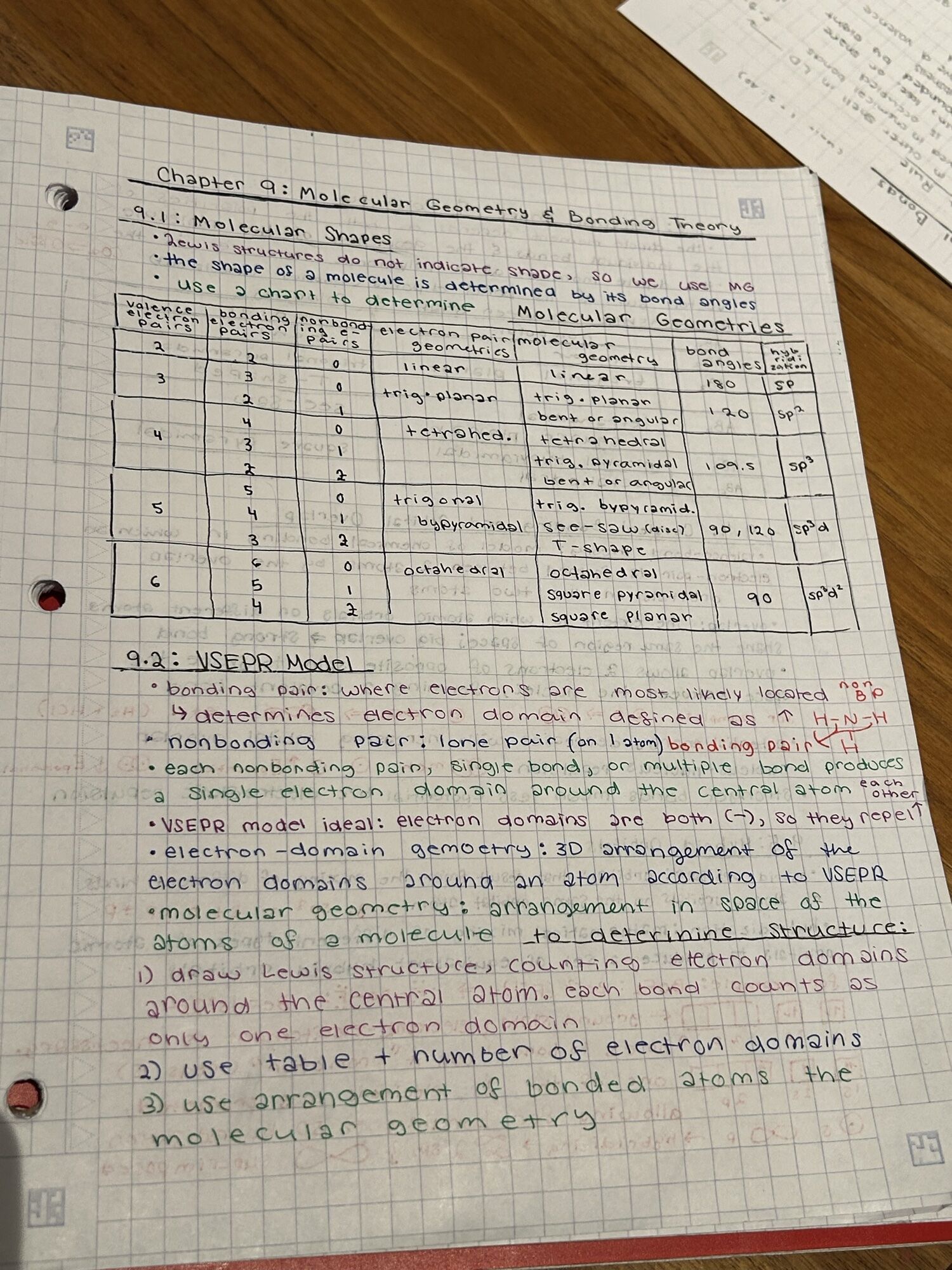
9.1 Molecular Shapes
- Lewis structures do not indicate shape, so we use molecular geometry (MG).
- The shape of a molecule is determined by its bond angles.
- Use a chart to determine. (Jaya’s chart merges cells that repeat; here every row is filled in, and the T-shape row gets its own angles, since a T has no 120° angle between atoms. “Disc.” is probably disphenoidal, another name for seesaw.)
Molecular geometries
| Valence electron pairs | Bonding electron pairs | Nonbonding e⁻ pairs | Electron-pair geometry | Molecular geometry | Bond angles | Hybridization |
|---|---|---|---|---|---|---|
| 2 | 2 | 0 | linear | linear | 180° | sp |
| 3 | 3 | 0 | trigonal planar | trigonal planar | 120° | sp² |
| 3 | 2 | 1 | trigonal planar | bent or angular | 120° | sp² |
| 4 | 4 | 0 | tetrahedral | tetrahedral | 109.5° | sp³ |
| 4 | 3 | 1 | tetrahedral | trigonal pyramidal | 109.5° | sp³ |
| 4 | 2 | 2 | tetrahedral | bent or angular | 109.5° | sp³ |
| 5 | 5 | 0 | trigonal bipyramidal | trigonal bipyramidal | 90°, 120° | sp³d |
| 5 | 4 | 1 | trigonal bipyramidal | see-saw (disc.) | 90°, 120° | sp³d |
| 5 | 3 | 2 | trigonal bipyramidal | T-shape | 90°, 180° | sp³d |
| 6 | 6 | 0 | octahedral | octahedral | 90° | sp³d² |
| 6 | 5 | 1 | octahedral | square pyramidal | 90° | sp³d² |
| 6 | 4 | 2 | octahedral | square planar | 90° | sp³d² |
Every shape in the chart, in 3D
| Bonding domains | 3 |
|---|---|
| Bond angles | less than 109.5° (107° in NH₃) |
| Hybridization | sp³ |
| Example | NH₃ |
- Electron-domain geometry
- tetrahedral
- Molecular geometry
- trigonal pyramidal
The purple lobes are lone pairs. They count as electron domains but aren't part of the molecular geometry.
- nitrogen
- hydrogen
9.2 VSEPR Model
- Bonding pair: where electrons are most likely located.
- Determines the electron domain, defined as in H–N–H with an H below the N: the three N–H bonds are bonding pairs, and the pair on N is a nonbonding pair.
- Nonbonding pair: a lone pair (on one atom).
- Each nonbonding pair, single bond, or multiple bond produces a single electron domain around the central atom.
- VSEPR model idea: electron domains are both (−), so they repel each other.
- Electron-domain geometry: the 3D arrangement of the electron domains around an atom according to VSEPR.
- Molecular geometry: the arrangement in space of the atoms of a molecule.
To determine structure:
- Draw the Lewis structure, counting electron domains around the central atom. Each bond counts as only one electron domain.
- Use the table and the number of electron domains.
- Use the arrangement of bonded atoms to find the molecular geometry.
NH₃
- Electron-domain geometry
- tetrahedral
- Molecular geometry
- trigonal pyramidal
The purple lobes are lone pairs. They count as electron domains but aren't part of the molecular geometry.
- nitrogen
- hydrogen
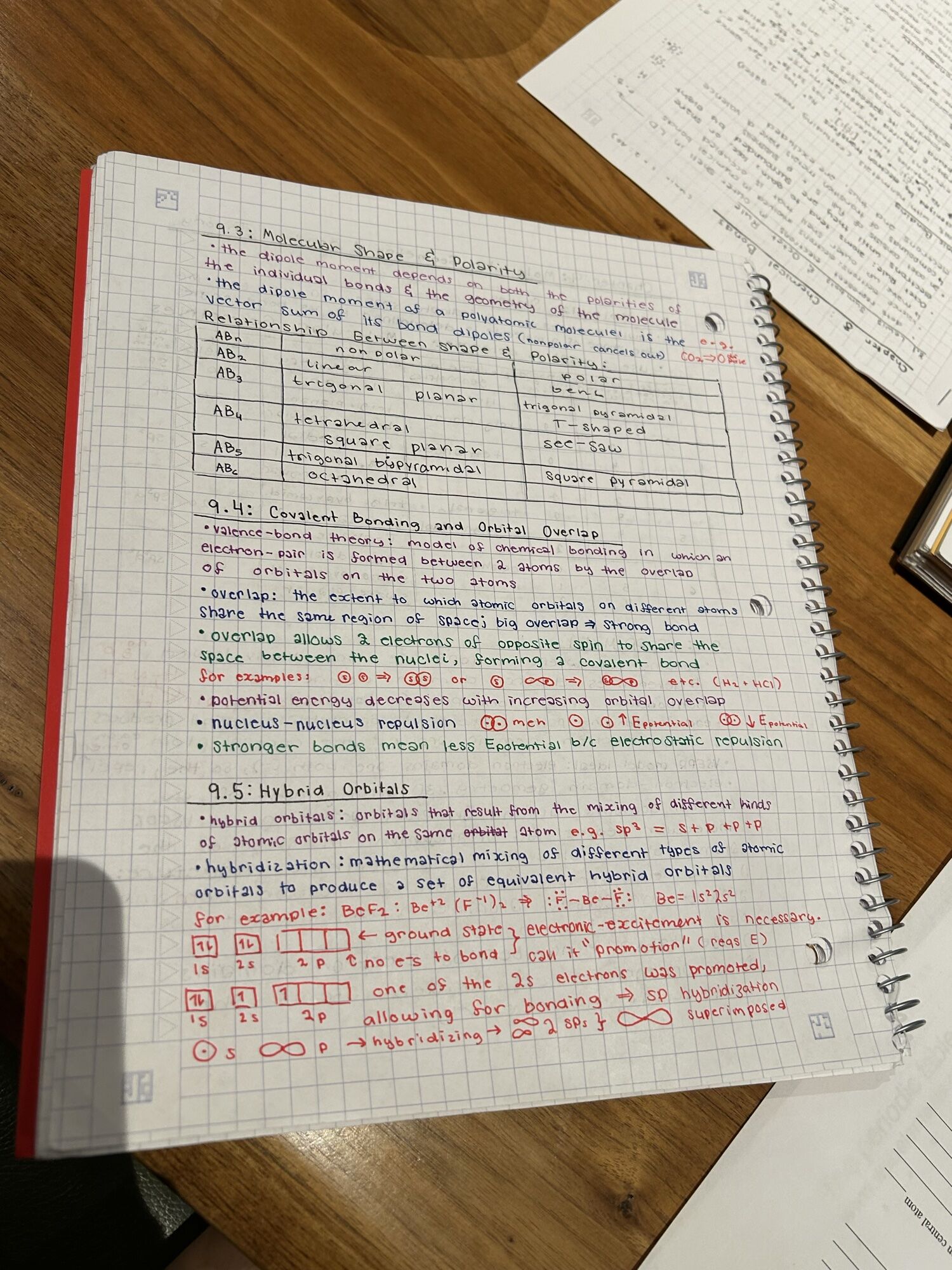
9.3 Molecular Shape & Polarity
- The dipole moment depends on both the polarities of the individual bonds and the geometry of the molecule.
- The dipole moment of a polyatomic molecule is the vector sum of its bond dipoles (nonpolar: they cancel out), e.g. CO₂ ⇒ 0 dipole.
Relationship between shape and polarity
| ABₙ | Nonpolar | Polar |
|---|---|---|
| AB₂ | linear | bent |
| AB₃ | trigonal planar | trigonal pyramidal, T-shaped |
| AB₄ | tetrahedral, square planar | see-saw |
| AB₅ | trigonal bipyramidal | |
| AB₆ | octahedral | square pyramidal |
9.4 Covalent Bonding and Orbital Overlap
- Valence-bond theory: a model of chemical bonding in which an electron-pair bond is formed between two atoms by the overlap of orbitals on the two atoms.
- Overlap: the extent to which atomic orbitals on different atoms share the same region of space. Big overlap ⇒ strong bond.
- Overlap allows 2 electrons of opposite spin to share the space between the nuclei, forming a covalent bond.
- For example: s + s (as in H₂) or s + p (as in HCl), etc.
- Potential energy decreases with increasing orbital overlap.
- Nucleus–nucleus repulsion: Jaya sketched two atoms side by side (higher potential energy) and two atoms with overlapping orbitals (lower potential energy).
- Stronger bonds mean less potential energy because of electrostatic repulsion.
9.5 Hybrid Orbitals
- Hybrid orbitals: orbitals that result from the mixing of different kinds of atomic orbitals on the same atom, e.g. sp³ = s + p + p + p.
- Hybridization: the mathematical mixing of different types of atomic orbitals to produce a set of equivalent hybrid orbitals.
For example, BeF₂: Jaya wrote it as Be²⁺(F⁻)₂ ⇒ :F̤–Be–F̤: with Be = 1s²2s².
| 1s | 2s | 2p | ||
|---|---|---|---|---|
| Ground state | ↑↓ | ↑↓ | ☐ ☐ ☐ | no electrons to bond |
| After promotion | ↑↓ | ↑ | ↑ ☐ ☐ | one of the 2s electrons was promoted |
- In the ground state there are no unpaired electrons to bond, so electronic excitement is necessary. It’s called promotion (it requires energy).
- One of the 2s electrons was promoted, allowing for bonding ⇒ sp hybridization.
- The s orbital and one p orbital, hybridizing → 2 sp orbitals, drawn superimposed along one axis (pointing opposite ways).
BeF₂
- Electron-domain geometry
- linear
- Molecular geometry
- linear
No lone pairs on the central atom, so both geometries are the same.
- beryllium
- fluorine
The originals
Jaya's notes as they were shared, before typing up. Select one to see it full size.