Lewis Structures, Formal Charge, and Resonance
Practice: Start 10 random questions on this lesson · Pick your own set
On this page 4 sections
1. Drawing a Lewis structure (8.5)
- Add up the valence electrons of all the atoms. For an anion, add one electron per negative charge. For a cation, subtract one per positive charge.
- Write the skeleton and connect the atoms with single bonds. The central atom is usually the least electronegative one, and it’s usually written first in the formula. H and F are never central, because each makes only one bond. In oxyacids (HOCl, HNO₃, H₂SO₄), each H is bonded to an O, not to the central atom. If two skeletons both work, formal charge (Section 2) decides.
- Complete the octets of the outer atoms with lone pairs (H gets only the 2 electrons in its bond).
- Put any leftover electrons on the central atom, in pairs.
- If the central atom has fewer than 8 electrons, move lone pairs from outer atoms into the bonds to make double or triple bonds, one pair at a time, until it has an octet.
At the end, count again: the dots and bond electrons together must equal the total from step 1.
Worked example: PCl₃
- P has 5 valence electrons and each Cl has 7: 5 + 3(7) = 26.
- P is less electronegative than Cl, so P is central, with three P–Cl bonds. That uses 6 electrons.
- Each Cl needs 3 lone pairs: 3 × 6 = 18 more. Running total: 24.
- The 2 left over go on P as a lone pair.
- P now has three bonds and a lone pair, which is 8 electrons. Done.
Worked example: HCN
- 1 + 4 + 5 = 10 valence electrons.
- H–C–N with two single bonds uses 4. H can’t be central.
- N gets 3 lone pairs (6 electrons). Running total: 10, so nothing is left.
- No leftovers.
- C has only 4 electrons (two bonds). Move two of N’s lone pairs into the C–N bond, making it triple. Now C has 8 (one single bond + one triple bond), and N has 8 (triple bond + one lone pair).
Result: H–C≡N with one lone pair on N.
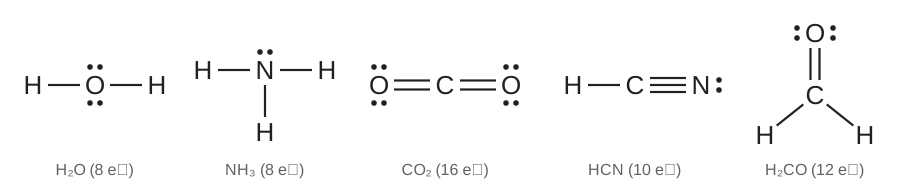
2. Formal charge
Sometimes more than one structure follows every rule. Formal charge helps pick the best one. It’s the charge an atom would have if every bond were shared exactly equally:
formal charge = (valence electrons) − (lone-pair electrons) − 1/2(bonding electrons)A shortcut for the last two terms: count every lone-pair dot plus one per bond line. Then subtract that count from the atom’s valence electrons.
The formal charges in a structure always add up to the overall charge (0 for a neutral molecule).
Choosing the best structure:
- Prefer the structure where the formal charges are as close to zero as possible.
- If some negative formal charge is needed, it belongs on the more electronegative atom.
Worked example: why CO₂ is O=C=O
Another structure with 16 electrons and octets everywhere is O≡C–O, with one lone pair on the triple-bonded O and three on the single-bonded O.
| Atom in O≡C–O | Valence e⁻ | Lone-pair e⁻ | Bonds | Formal charge |
|---|---|---|---|---|
| O (triple) | 6 | 2 | 3 | +1 |
| C | 4 | 0 | 4 | 0 |
| O (single) | 6 | 6 | 1 | −1 |
In O=C=O every atom has a formal charge of 0, so O=C=O is the better structure.
The cyanate ion, OCN⁻ (16 valence electrons), has three structures with octets on every atom. All three have formal charges adding to −1, but they are not equally good:
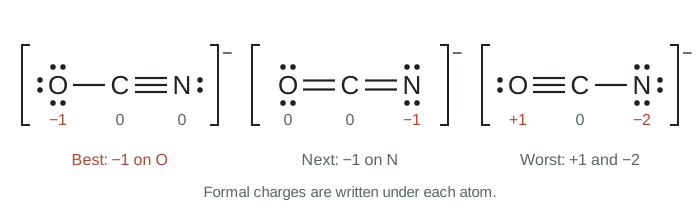
The first two each have only one nonzero formal charge, so the tiebreaker decides: the first is best because its −1 sits on oxygen, the most electronegative atom. The third puts a positive charge on oxygen and a −2 on nitrogen, so it contributes almost nothing.
Formal charge vs. oxidation number
Both are bookkeeping, and they make opposite assumptions:
- Formal charge pretends bonding electrons are shared equally.
- Oxidation number pretends they belong entirely to the more electronegative atom.
In CO₂, carbon’s formal charge is 0, but its oxidation number is +4. Neither is the atom’s real charge, which is somewhere in between. Formal charge also isn’t used to find a dipole moment, which depends on the real partial charges (δ+ and δ−).
“Obey the octet rule” vs. “minimize formal charge”
For molecules with a period 3 central atom, these two instructions can give different structures. Thionyl chloride, SOCl₂ (S central, 26 valence electrons), is the standard example:
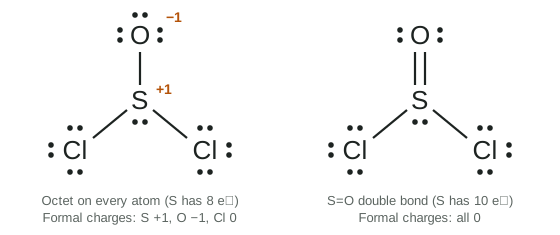
- If the question says obey the octet rule, draw the single-bond structure on the left.
- If it says minimize formal charge, draw the S=O structure on the right. S can hold 10 electrons because it’s in period 3.
Worked example: octet structures with formal charges and oxidation numbers
Each structure below obeys the octet rule. The formal charges and the oxidation numbers each add up to the overall charge.
| Species | Octet structure | Formal charges | Oxidation numbers |
|---|---|---|---|
| OCS | O=C=S | all 0 | O −2, C +4, S −2 |
| SOCl₂ | S bonded to O and 2 Cl, one lone pair on S | S +1, O −1, Cl 0 | S +4, O −2, Cl −1 |
| BrO₃⁻ | Br bonded to 3 O, one lone pair on Br | Br +2, each O −1 | Br +5, O −2 |
| HClO₂ | H–O–Cl–O, all single bonds | H 0, O(H) 0, Cl +1, end O −1 | H +1, Cl +3, O −2 |
The formal charge on Cl in HClO₂, step by step (2 lone pairs, 2 bonds):
FC = 7 − 4 − 1/2(4) = +1Sulfuric acid, H₂SO₄ (32 valence electrons, each H on an O), works the same way. The octet structure has four S–O single bonds, with S at +2 and the two O atoms without H at −1. Changing those two bonds to S=O makes every formal charge 0 and puts 12 electrons around S.
3. Resonance (8.6)
Some molecules can’t be described by one Lewis structure. In the nitrite ion, NO₂⁻, the double bond can be drawn to either oxygen:
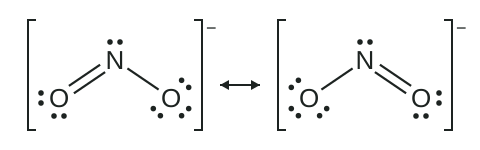
Experiments show both N–O bonds are identical: same length, shorter than an N–O single bond and longer than an N=O double bond. Neither drawing is right on its own. The real ion is a resonance hybrid, a blend of both, with the extra bonding spread evenly over the two N–O bonds. Ozone, O₃, works exactly the same way.
Rules for resonance structures:
- Only electrons move (lone pairs and the second or third pair of a multiple bond). Atoms stay in the same places.
- Every resonance structure has the same total number of electrons.
- Draw them with a double-headed arrow (↔) between them.
Bond order in a resonance hybrid is the average over the structures. The carbonate ion has three:
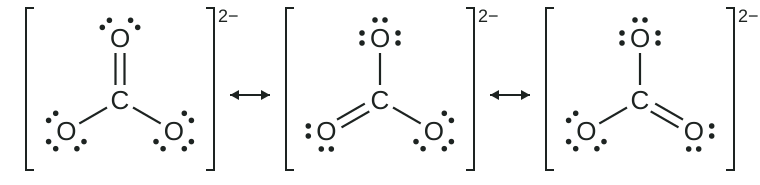
Each C–O bond is a double bond in one structure and a single bond in two, so its bond order is (2 + 1 + 1)/3 = 4/3. Nitrate, NO₃⁻, also has three resonance structures and the same 4/3 bond order. In nitrite and ozone, each bond has order (2 + 1)/2 = 3/2.
Another way to draw it: the resonance hybrid
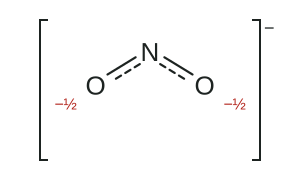
Instead of drawing every resonance structure, you can draw the hybrid in one picture (usually without the lone pairs). Each bond that’s double in some structures and single in others gets one solid line plus one dashed line (the dashed part is the π bond spread over several places), and the charge is split among the atoms that carry it in the different structures, written as a fraction or as δ−.
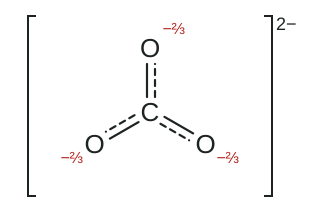
Carbonate’s 2− charge is on two of the three O atoms in each structure, so on average each O carries −2/3. In nitrite, the 1− charge is on one O or the other, so each gets −1/2:
What the hybrid looks like with orbitals
The dashed lines are the picture of the π electrons being shared by every bond at once (delocalized). Step through carbonate: one structure puts the π bond (pink) in one place, but all four atoms have parallel p orbitals, so the real π electrons spread over the whole ion. There’s more on this in the Chapter 9 lesson on hybrid orbitals.
CO₃²⁻, step 1: One resonance structure has a C=O π bond to just one of the three O atoms. It would make that bond shorter than the other two, but in real carbonate all three are the same.
- p orbital
- σ bond
- π electrons
Sulfur dioxide, SO₂, has 18 valence electrons, the same as ozone, because S and O are both in group 16. Species with the same number of electrons are isoelectronic. Ozone is an allotrope of oxygen: one of the forms an element can take in the same physical state (O₂ and O₃ are both oxygen gases; diamond and graphite are both solid carbon). Like ozone, SO₂ has two equivalent resonance structures (O=S–O and O–S=O, lone pair on S), so both S–O bonds have order 3/2. They are the same length, shorter than an S–O single bond and longer than an S=O double bond.
Sulfur trioxide, SO₃, drawn with an octet on S, has one S=O and two S–O bonds, so it has three equivalent resonance structures. All three real bonds are the same (order 4/3). The S atom has four bonds and no lone pairs, so its formal charge is 6 − 0 − 4 = +2.
Benzene
Benzene, C₆H₆, is a ring of six carbons with alternating single and double bonds, and the double bonds can be drawn in two different positions. All six C–C bonds are really the same length, 1.40 Å, between a C–C single bond (1.54 Å) and a C=C double bond (1.34 Å). Chemists often draw it as a hexagon with a circle inside to show the electrons spread around the ring.
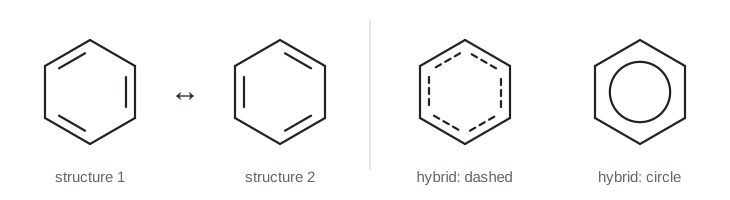
The CED doesn’t name benzene. If it comes up on the AP exam, it’s as a resonance example: be able to say why all six bonds are the same length. The circle drawing isn’t required.
4. Exceptions to the octet rule (8.7)
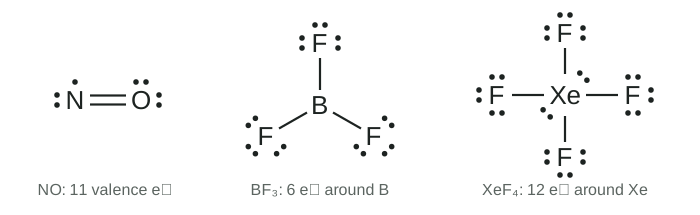
Odd number of electrons
If the total number of valence electrons is odd, one electron has to be unpaired. Examples are NO (11), NO₂ (17), ClO (13), and ClO₂ (19). These molecules are called radicals, and they’re usually very reactive. Compare the chlorine–oxygen ions ClO⁻ (14), ClO₂⁻ (20), ClO₃⁻ (26), and ClO₄⁻ (32): each has an even count, and each can be drawn with an octet on every atom.
Fewer than an octet
Boron and beryllium often end up with fewer than 8 electrons. In BF₃, boron has only 6. You could give it an octet with a B=F double bond, but that puts a +1 formal charge on fluorine, the most electronegative element, so the 6-electron structure is the better one.
Boron’s empty spot makes BF₃ reactive toward molecules with a lone pair. With ammonia, the N lone pair forms a bond to B, and B gets its octet:
BF₃ + NH₃ → F₃B − NH₃More than an octet
Atoms from period 3 and below (P, S, Cl, Xe, I, and so on) can have more than 8 electrons around them: PCl₅ has 10 around P, SF₆ has 12 around S, and XeF₄ has 12 around Xe (four bonds and two lone pairs). Period 2 atoms (C, N, O, F) never do.
The reason is mostly size. A larger central atom has room for five or six atoms around it. Small period 2 atoms don’t.
When drawing these, follow steps 1–4 as usual. After every outer atom has its octet, the leftover electrons go on the central atom, even if it already has 8.
Worked example: ICl₄⁻
- 7 + 4(7) + 1 = 36 electrons.
- I is central with four I–Cl bonds: 8 electrons.
- Each Cl gets 3 lone pairs: 4 × 6 = 24. Running total: 32.
- The last 4 electrons go on I as two lone pairs. I has 4 bonds + 2 lone pairs = 12 electrons.