Covalent Bonds, Electronegativity, and Bond Polarity
Practice: Start 10 random questions on this lesson · Pick your own set
On this page 5 sections
1. Covalent bonds (8.3)
Nonmetal atoms don’t give up electrons easily, so instead of transferring electrons they share them. In H₂, both nuclei attract the shared pair of electrons sitting between them, and that attraction holds the atoms together.
In a Lewis structure, each shared pair is drawn as a line, and electrons that belong to one atom only are drawn as dots, called lone pairs (or nonbonding pairs).
| Molecule | Bonds to F, O, N, or C | Lone pairs on that atom | Electrons around that atom |
|---|---|---|---|
| HF | 1 | 3 on F | 8 |
| H₂O | 2 | 2 on O | 8 |
| NH₃ | 3 | 1 on N | 8 |
| CH₄ | 4 | 0 on C | 8 |
Each atom ends up with an octet by counting both electrons of every bond it’s in, plus its own lone pairs. The bond count matches the Lewis symbols from the last lesson: F makes 1 bond, O 2, N 3, C 4.
Multiple bonds
Atoms can share more than one pair:
- single bond: one shared pair, as in H − H or Cl − Cl
- double bond: two shared pairs, as in O = O or O = C = O
- triple bond: three shared pairs, as in N ≡ N
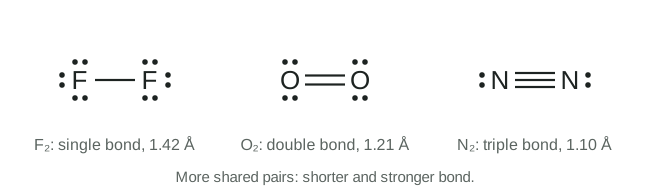
The more pairs two atoms share, the shorter and stronger the bond:
| Bond | N–N | N=N | N≡N |
|---|---|---|---|
| Length (Å) | 1.47 | 1.24 | 1.10 |
2. Electronegativity (8.4)
Electronegativity is an atom’s ability to attract the electrons in a bond toward itself. The textbook uses Linus Pauling’s scale, which runs from 0.7 (Cs) to 4.0 (F).
| Period | Group 1 | 2 | 13 | 14 | 15 | 16 | 17 |
|---|---|---|---|---|---|---|---|
| 1 | H 2.1 | ||||||
| 2 | Li 1.0 | Be 1.5 | B 2.0 | C 2.5 | N 3.0 | O 3.5 | F 4.0 |
| 3 | Na 0.9 | Mg 1.2 | Al 1.5 | Si 1.8 | P 2.1 | S 2.5 | Cl 3.0 |
| 4 | K 0.8 | Ca 1.0 | Br 2.8 | ||||
| 5 | I 2.5 |
Electronegativity increases left to right across a period and decreases down a group, the same direction as ionization energy and for the same reasons (Zeff and distance). Metals have low values and nonmetals have high ones. The four most electronegative elements are F > O > N ≈ Cl.
3. Bond polarity
The difference in electronegativity (ΔEN) between two bonded atoms tells you how evenly the electrons are shared:
| Bond type | ΔEN | Example | What happens |
|---|---|---|---|
| Nonpolar covalent | 0 (or very small) | F–F: 4.0 − 4.0 = 0 | electrons shared equally |
| Polar covalent | in between | H–F: 4.0 − 2.1 = 1.9 | electrons pulled toward F |
| Ionic | large (around 2 or more) | Li–F: 4.0 − 1.0 = 3.0 | electron essentially transferred to F |
H–F, at 1.9, is close to the boundary but is still a molecule with a polar covalent bond.
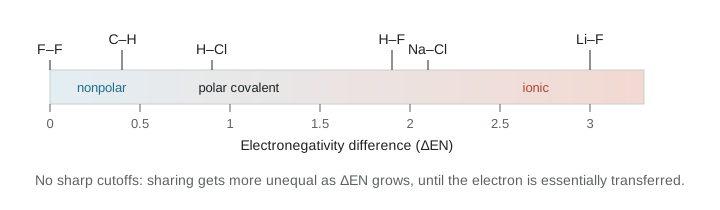
These are points on a continuum, not separate boxes, so there’s no exact cutoff. A C–H bond (ΔEN = 0.4) is usually treated as nonpolar.
In a polar bond the more electronegative atom gets a partial negative charge (δ−), and the other gets a partial positive charge (δ+):
H − FThe bond can also be drawn with a crossed arrow (+→) pointing toward the δ− end.
Worked example: order bonds by polarity
Put these bonds in order of increasing polarity: C–O, C–F, C–N, C–C.
ΔEN values: C–C 0, C–N 0.5, C–O 1.0, C–F 1.5.
Increasing polarity: C–C < C–N < C–O < C–F. In every polar one, carbon is the δ+ end.
4. Dipole moments
Two equal and opposite charges separated by a distance form a dipole. Its size is the dipole moment, μ = Q r, where Q is the size of the charge on each end and r is the distance between them. You won’t calculate it in this class, but the relationship tells you what makes a dipole bigger:
- larger partial charges, which come from a bigger ΔEN, or
- a longer bond, which separates those charges more.
Of the two, ΔEN usually wins. From HF to HI the bond gets longer, but ΔEN falls from 1.9 to 0.4, so the partial charges shrink far more than the distance grows. HF has the largest dipole moment of the hydrogen halides and HI the smallest.
5. Ionic or covalent?
“Metal + nonmetal = ionic” is a good first guess, and the ΔEN guide above usually agrees. But the textbook points out exceptions: when a metal is in a high oxidation state (about +4 or higher), its compounds behave like molecules.
- TiCl₄ (titanium in the +4 state) is a liquid at room temperature that boils at 136 °C. An ionic solid would melt hundreds of degrees higher.
- MnO (Mn in the +2 state) is an ionic solid with a high melting point, while Mn₂O₇ (Mn in the +7 state) is a liquid at room temperature.
Names follow the same split. Compounds that behave ionically get ionic names, like manganese(II) oxide, while molecular ones are often given molecular names, like dimanganese heptoxide or titanium tetrachloride.
Sorting substances by bond type
| Substance | Bonding | Why |
|---|---|---|
| iron | metallic | metal atoms only |
| sodium chloride | ionic | metal + nonmetal, Na⁺ and Cl⁻ ions |
| water | covalent | two nonmetals sharing electrons |
| oxygen, O₂ | covalent | two O atoms sharing electrons (a double bond) |
| argon | none | a noble gas exists as single atoms, so there are no bonds at all |
A low boiling point is a clue too. Boiling an ionic compound means pulling ions apart, so ionic compounds boil at hundreds or thousands of degrees (NaCl boils at 1413 °C). A compound of two elements that boils at −33 °C must be made of separate molecules held together only by weak forces, so it’s covalent. (NH₃ is one: it boils at −33 °C.)