Bond Enthalpies and Bond Lengths
Practice: Start 10 random questions on this lesson · Pick your own set
On this page 3 sections
1. Bond enthalpy
The book first uses bond enthalpies to estimate ΔH in Chapter 5 (Section 5.8). Section 8.8 comes back to them to compare how strong and how long different bonds are. Both parts are here.
Bond enthalpy is the enthalpy change for breaking one mole of a particular bond in a gaseous substance:
Cl₂(g) → 2 Cl(g) ΔH = D(Cl − Cl) = 242 kJ/molBreaking a bond always takes energy, so bond enthalpies are always positive. Forming the same bond releases the same amount.
For a bond that appears in many different molecules, like C–H, the exact value changes a little from molecule to molecule. Tables list an average bond enthalpy.
| Bond | kJ/mol | Bond | kJ/mol | Bond | kJ/mol |
|---|---|---|---|---|---|
| H–H | 436 | C–C | 348 | O–H | 463 |
| C–H | 413 | C=C | 614 | O=O | 495 |
| N–H | 391 | C≡C | 839 | C–O | 358 |
| H–Cl | 431 | N–N | 163 | C=O (in CO₂) | 799 |
| Cl–Cl | 242 | N≡N | 941 | C≡O | 1072 |
2. Estimating ΔH from bond enthalpies
A reaction breaks some bonds and forms others. Breaking costs energy and forming releases it:
ΔH_rxn ≈ ∑D(bonds broken) − ∑D(bonds formed)Broken minus formed, the reverse of the products-minus-reactants order you use with enthalpies of formation. If the bonds formed are stronger than the bonds broken, ΔH is negative and the reaction is exothermic.
Worked example: H₂ + Cl₂ → 2HCl
Broken: one H–H (436) and one Cl–Cl (242), total 678 kJ.
Formed: two H–Cl, 2 × 431 = 862 kJ.
ΔH ≈ 678 − 862 = −184 kJWorked example: burning methane
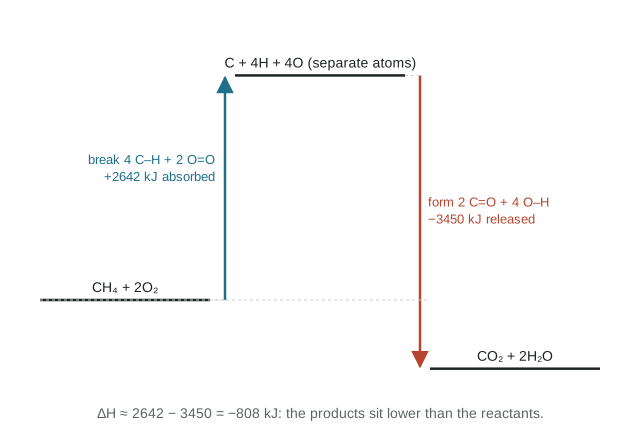
Draw the Lewis structures first so you know every bond: CH₄ has four C–H bonds, each O₂ has one O=O, CO₂ has two C=O, and each H₂O has two O–H.
| Bonds | kJ | |
|---|---|---|
| Broken | 4 C–H + 2 O=O | 4(413) + 2(495) = 2642 |
| Formed | 2 C=O + 4 O–H | 2(799) + 4(463) = 3450 |
The measured value is −802 kJ. The estimate is close but not exact, because the table holds averages.
A shortcut for bigger molecules: list the bonds on each side and cross out the ones that appear on both. Only the bonds that change affect ΔH. In H₂C = CH₂ + H₂O₂ → HOCH₂CH₂OH, the four C–H and two O–H bonds are on both sides. What changes is C=C and O–O broken, and one C–C and two C–O formed.
3. Bond order, strength, and length
Bond order is the number of shared pairs: 1 for a single bond, 2 for a double, 3 for a triple. Between the same two atoms, a higher bond order means a stronger and shorter bond, because more shared electrons between the nuclei pull them closer together.
| Bond | Length (Å) | Bond | Length (Å) | Bond | Length (Å) |
|---|---|---|---|---|---|
| C–C | 1.54 | C–N | 1.43 | C–O | 1.43 |
| C=C | 1.34 | C=N | 1.38 | C=O | 1.23 |
| C≡C | 1.20 | C≡N | 1.16 | C≡O | 1.13 |
Typical bond lengths are 1–2 Å. A distance of 5–10 Å would span several bonds.
Two details are easy to miss:
- A double bond is stronger than a single bond but not twice as strong: C=C is 614 kJ/mol, while two C–C bonds would be 696.
- Bond length also depends on the size of the atoms. Down a group the bonds get longer and usually weaker: H–F is shorter and stronger than H–Cl, which is shorter and stronger than H–Br.
For resonance structures, use the averaged bond order from the last lesson. A bond of order 1.5 has a length between the single and double bond lengths.
The connection between bond length and bond energy is easiest to see on a graph of potential energy vs. distance between the nuclei. That graph is in the Chapter 9 lesson on orbital overlap.