Lewis Symbols and Ionic Bonding
Practice: Start 10 random questions on this lesson · Pick your own set
On this page 6 sections
1. Three kinds of bonds
A chemical bond is the attraction that holds atoms together. Chapter 8 sorts bonds into three types:
| Bond | Between | What happens to the electrons | Example |
|---|---|---|---|
| Ionic | a metal and a nonmetal | transferred from the metal to the nonmetal, making ions that attract each other | NaCl |
| Covalent | nonmetals | shared between two atoms | H₂O, Cl₂ |
| Metallic | metal atoms | free to move through the whole solid; each metal atom is held by the “sea” of electrons around it | Cu, Fe |
This lesson covers ionic bonds. The next one covers covalent bonds.
2. Lewis symbols and the octet rule (8.1)
Only valence electrons take part in bonding. A Lewis symbol is the element’s symbol with one dot for each valence electron. Put the dots on the four sides of the symbol, one per side, before pairing any up.

The number of dots equals the group number for groups 1–2 and the group number minus 10 for groups 13–18.
The number of unpaired dots tells you how many bonds a nonmetal usually makes: C makes 4, N makes 3, O makes 2, and F makes 1.
The octet rule: atoms tend to gain, lose, or share electrons until they are surrounded by eight valence electrons, the configuration of a noble gas (ns² np⁶). Hydrogen is the exception that stops at two, like He. The rule has many exceptions (Section 8.7), but it works for most compounds of period 2 elements.
3. Why ionic compounds form (8.2)
When sodium metal reacts with chlorine gas, an electron moves from each Na to a Cl:
Na(s) + 1/2 Cl₂(g) → NaCl(s) ΔH_f° = −411 kJThe reaction is strongly exothermic, but the electron transfer itself is not where the energy comes from:
- Removing Na’s electron costs 496 kJ/mol (its first ionization energy).
- Adding that electron to Cl releases only 349 kJ/mol (its electron affinity is −349 kJ/mol).
Making a gaseous Na⁺ and a gaseous Cl⁻ from the atoms is therefore uphill by about 147 kJ/mol. What makes the compound stable is the huge amount of energy released when the oppositely charged ions pack together into a solid. That energy is the lattice energy.
Showing the transfer with Lewis symbols
Lewis symbols show where the electrons go. Magnesium’s two valence electrons move to oxygen, which fills oxygen’s two unpaired spots:
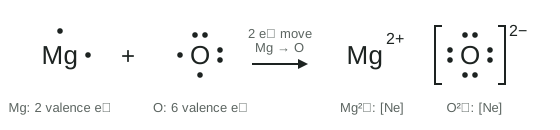
Draw the anion in brackets with its charge outside, and leave the cation with no dots. The two ions are written side by side without a plus sign, because together they are the one product, MgO. (On paper you can add curved arrows from each Mg dot to O to show the transfer.)
Predicting the formula
Take each ion’s charge from its group, then use the smallest whole-number ratio that makes the total charge zero:
| Group | 1 | 2 | 13, plus Sc and Y | 15 | 16 | 17 |
|---|---|---|---|---|---|---|
| Ion charge | +1 | +2 | +3 | −3 | −2 | −1 |
| Elements | Ions | Formula |
|---|---|---|
| Al and F | Al³⁺, F⁻ | AlF₃ |
| K and S | K⁺, S²⁻ | K₂S |
| Mg and N | Mg²⁺, N³⁻ | Mg₃N₂: 3(+2) = +6 balances 2(−3) = −6 |
| Y and O | Y³⁺, O²⁻ | Y₂O₃: 2(+3) = +6 balances 3(−2) = −6 |
Yttrium is [Kr] 4d¹5s². Its 4d electron is in a lower shell than the 5s electrons, but the 4d and 5s energies are close, so all three count as valence electrons. Losing all three leaves Y³⁺ as [Kr]. Scandium, one row up, does the same thing and forms Sc³⁺.
4. Lattice energy
Lattice energy is the energy required to completely separate one mole of a solid ionic compound into its gaseous ions:
NaCl(s) → Na⁺(g) + Cl⁻(g) ΔH_lattice = +788 kJ/molIt is always positive, because you’re pulling apart ions that attract each other. A larger lattice energy means a more stable solid, with stronger attractions between its ions.
Coulomb’s law sets the size
The potential energy of two interacting charged particles is
E_el = (κ Q₁Q₂)/dwhere Q₁ and Q₂ are the charges on the ions and d is the distance between their centers. So lattice energy:
- increases as the ion charges increase (the product Q₁Q₂ goes up), and
- increases as the ions get smaller (smaller ions sit closer together, so d is smaller).
Charge usually matters more than size. Going from +1/−1 ions to +2/−2 ions multiplies Q₁Q₂ by 4, while changing to the next ion down a group with the same charge changes d by roughly 10–15% (NaCl to KCl takes d from about 2.8 Å to 3.2 Å).
| Compound | Ion charges | Lattice energy (kJ/mol) |
|---|---|---|
| KCl | +1, −1 | 701 |
| NaCl | +1, −1 | 788 |
| LiF | +1, −1 | 1030 |
| MgCl₂ | +2, −1 | 2326 |
| CaO | +2, −2 | 3414 |
| MgO | +2, −2 | 3795 |
Among the +1/−1 salts, the smaller ions give the larger lattice energy (LiF > NaCl > KCl). Every compound with a +2 ion is far above all of them. Comparing different formula types is less direct: MgCl₂ is about three times NaCl, not twice, partly because each formula unit has three ions instead of two.
Worked example: rank by lattice energy
Rank NaF, CaO, and NaBr from smallest to largest lattice energy.
- CaO has +2 and −2 ions. Its charge product (4) is four times the others’ (1), so it’s the largest by far.
- NaF and NaBr both have +1/−1 ions and the same cation. F⁻ is smaller than Br⁻, so the ions in NaF are closer together and attract more strongly.
Smallest to largest: NaBr < NaF < CaO.
Properties of ionic solids
The ions sit in a repeating three-dimensional lattice, each cation surrounded by anions and each anion by cations. That structure explains how ionic solids behave:
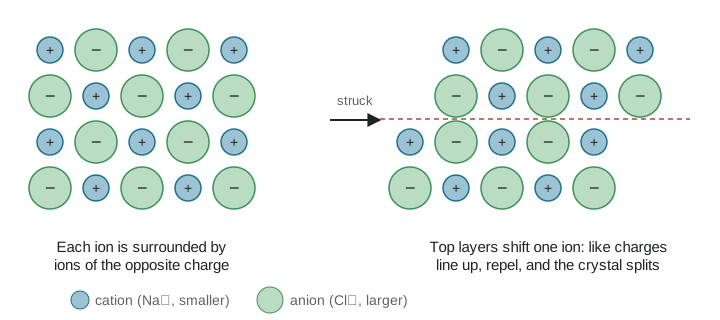
- High melting points, because many strong attractions have to be overcome. Higher lattice energy generally means a higher melting point (MgO melts near 2800 °C, NaCl at 801 °C).
- Brittle: a sharp blow shifts one layer of ions, lining up like charges, and the repulsion splits the crystal.
- Don’t conduct as solids, because the ions are locked in place. Do conduct when melted or dissolved in water, because the ions can then move.
5. The Born–Haber cycle
Lattice energy can’t be measured directly. Instead the formation of the solid from its elements is broken into steps whose energies are known, and Hess’s law gives the missing step. That cycle of steps is called a Born–Haber cycle.
For a compound MX made from a metal M and a diatomic halogen X₂:
| Step | Energy |
|---|---|
| 1. M(s) → M(g) | enthalpy of sublimation (+) |
| 2. 1/2 X₂ → X(g) | half the X–X bond enthalpy (+); for Br₂(l) or I₂(s), the formation enthalpy of the gaseous atom |
| 3. M(g) → M⁺(g) + e⁻ | first ionization energy (+) |
| 4. X(g) + e⁻ → X⁻(g) | electron affinity (−) |
| 5. M⁺(g) + X⁻(g) → MX(s) | −(lattice energy) |
| Sum: M(s) + 1/2 X₂ → MX(s) | ΔH_f° of MX |
So
ΔH_f° = ΔH_sub + 1/2D + IE₁ + EA − ΔH_lattice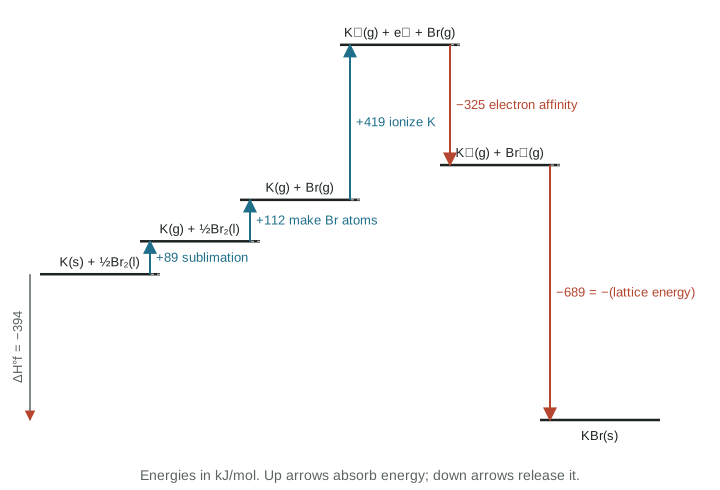
Rearranged, ΔH_lattice = ΔH_sub + 1/2D + IE₁ + EA − ΔH_f°.
Worked example: lattice energy of KBr
Use these values (kJ/mol) to find the lattice energy of KBr.
| K(s) → K(g) | 1/2 Br₂(l) → Br(g) | IE₁ of K | EA of Br | ΔH_f° of KBr(s) |
|---|---|---|---|---|
| +89 | +112 | +419 | −325 | −394 |
Watch the last term. Subtracting a negative ΔH_f° adds 394.
Tables built from other data list about 671 kJ/mol for KBr. The cycle’s answer depends on the values put into it, so use the numbers the question gives.
6. Electron configurations of ions
Ions of the group 1 and 2 metals, aluminum, and the nonmetals reach a noble-gas configuration:
- Metals lose their valence electrons: Mg [Ne] 3s² → Mg²⁺ [Ne].
- Nonmetals gain electrons to fill their p subshell: N [He] 2s²2p³ → N³⁻ [He] 2s²2p⁶ = [Ne].
Ions don’t go past a noble-gas configuration, because removing a core electron costs far more energy than the lattice can pay back. That’s why sodium forms Na⁺ and never Na²⁺.
Heavier main-group metals past the transition metals don’t all reach a noble-gas configuration. Ga³⁺ is [Ar] 3d¹⁰, a filled d subshell instead.
Transition-metal ions lose their ns electrons first, then (n − 1)d electrons, even though 4s filled before 3d:
Fe [Ar] 3d⁶4s² → Fe²⁺ [Ar] 3d⁶ → Fe³⁺ [Ar] 3d⁵Most transition-metal ions don’t have noble-gas configurations, which is part of why many of these metals form more than one ion.
Noble-gas shorthand is not the same as a noble-gas configuration
Almost any ion can be written with noble-gas shorthand: Rh³⁺ is [Kr] 4d⁶. That’s just notation. An ion has a noble-gas configuration only when its whole arrangement matches a noble gas, with nothing written after the bracket.
| Ion | Configuration | Noble-gas configuration? |
|---|---|---|
| Rb⁺ | [Kr] | yes (Kr) |
| Sc³⁺ | [Ar] | yes (Ar) |
| P³⁻, S²⁻ | [Ne] 3s²3p⁶ = [Ar] | yes (Ar) |
| V²⁺ | [Ar] 3d³ | no |
| Rh³⁺ | [Kr] 4d⁶ | no |
Rhodium is [Kr] 4d⁸5s¹, an exception to the filling order. It loses the 5s electron first, then two 4d electrons, and ends at [Kr] 4d⁶.