Jaya's Notes: Chapter 8
A classmate's notes, with the wording kept as close to the original as possible. Where something needed fixing, there's a Correction box right below it. See the original pages.
Practice: Start 10 random questions from Chapter 8 · Pick your own set
On this page 9 sections
8.1 Lewis Symbols & Octet Rule
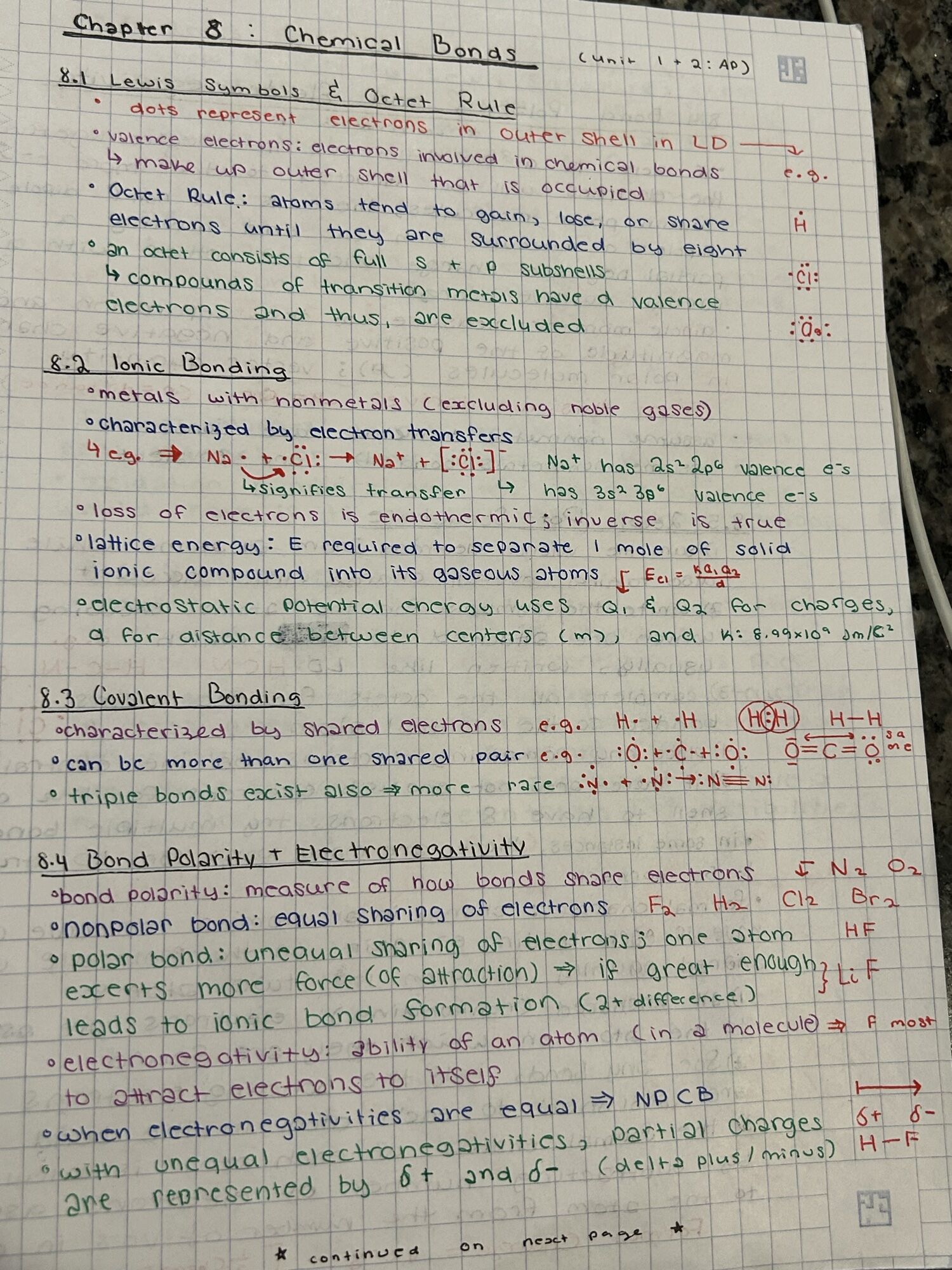
- Dots represent electrons in the outer shell in a Lewis dot (LD) symbol, e.g. H·, ·Cl with 7 dots, ·O with 6 dots.
- Valence electrons: electrons involved in chemical bonds.
- They make up the outer shell that is occupied.
- Octet Rule: atoms tend to gain, lose, or share electrons until they are surrounded by eight.
- An octet consists of full s + p subshells.
- Compounds of transition metals have d valence electrons and thus are excluded.
8.2 Ionic Bonding
-
Metals with nonmetals (excluding noble gases).
-
Characterized by electron transfers, e.g.
Na⋅ + ⋅Cl → Na⁺ + [Cl]⁻The curved arrow in a drawing signifies the transfer. Na⁺ has 2s²2p⁶ valence electrons and Cl⁻ has 3s²3p⁶.
-
Loss of electrons is endothermic; the inverse is true.
- Lattice energy: energy required to separate 1 mole of solid ionic compound into its gaseous atoms.
-
Electrostatic potential energy uses Q₁ and Q₂ for the charges, d for the distance between centers (m), and κ = 8.99 × 10⁹ J⋅m/C²:
E_el = κQ₁Q₂/d
8.3 Covalent Bonding
- Characterized by shared electrons, e.g. H⋅ + ⋅H → H − H.
- There can be more than one shared pair, e.g. O = C = O.
- Triple bonds exist also, but they’re more rare, e.g. N ≡ N.
8.4 Bond Polarity + Electronegativity
- Bond polarity: a measure of how bonds share electrons.
- Nonpolar bond: equal sharing of electrons, e.g. N₂, O₂, F₂, H₂, Cl₂, Br₂.
- Polar bond: unequal sharing of electrons; one atom exerts more force of attraction, e.g. HF. If the difference is great enough (2+ difference), it leads to ionic bond formation, e.g. LiF.
- Electronegativity: the ability of an atom (in a molecule) to attract electrons to itself. F is the most electronegative.
- When electronegativities are equal ⇒ nonpolar covalent bond.
- With unequal electronegativities, partial charges are represented by δ+ and δ− (delta plus/minus): H − F, with the arrow pointing toward F.
- If there’s a big difference in electronegativities, the electrons will be attracted to the more electronegative atom.
- Within polar molecules, there is a nonzero dipole moment.
- Dipole: a molecule with one end having a partial negative charge and the other a partial positive charge.
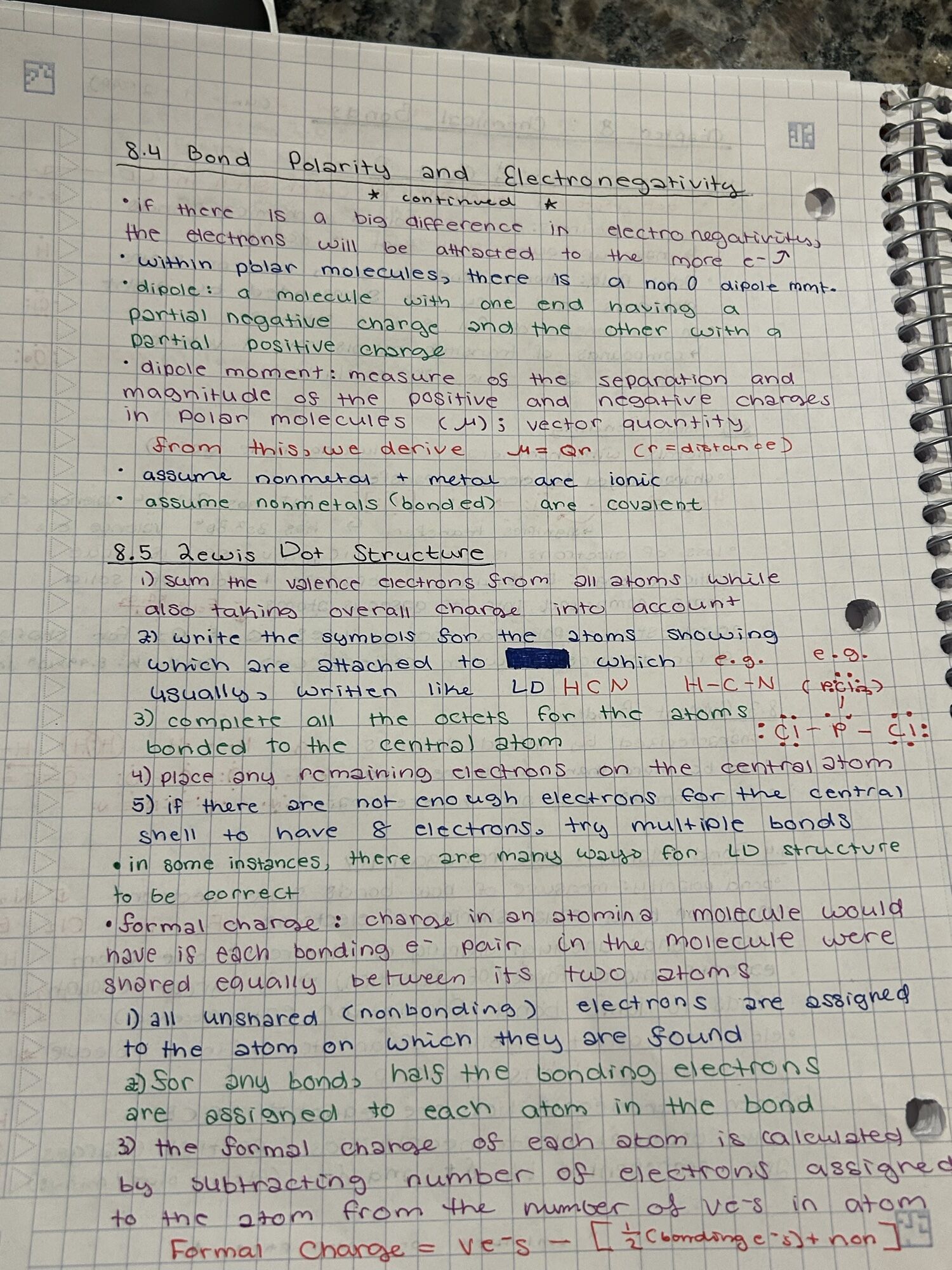
- Dipole moment: measure of the separation and magnitude of the positive and negative charges in polar molecules (μ); a vector quantity. From this we derive μ = Qr (r = distance).
- Assume nonmetal + metal are ionic.
- Assume nonmetals bonded together are covalent.
8.5 Lewis Dot Structure
- Sum the valence electrons from all atoms, while also taking the overall charge into account.
- Write the symbols for the atoms, showing which are attached to which. Usually written like the formula, e.g. HCN → H–C–N.
- Complete all the octets for the atoms bonded to the central atom, e.g. PCl₃.
- Place any remaining electrons on the central atom.
- If there are not enough electrons for the central atom to have 8 electrons, try multiple bonds.
- In some instances, there are many ways for a Lewis structure to be correct.
- Formal charge: the charge an atom in a molecule would have if each bonding electron pair in the
molecule were shared equally between its two atoms.
- All unshared (nonbonding) electrons are assigned to the atom on which they’re found.
- For any bond, half the bonding electrons are assigned to each atom in the bond.
- The formal charge of each atom is calculated by subtracting the number of electrons assigned to the atom from the number of valence electrons in the atom.
How to identify the dominant Lewis structure (LDS)
- The dominant Lewis structure is generally the one in which the atoms bear formal charges that are closest to 0.
- A Lewis structure in which any negative charges reside on the more electronegative atoms is generally more dominant than one that has negative charges on the less electronegative atoms.
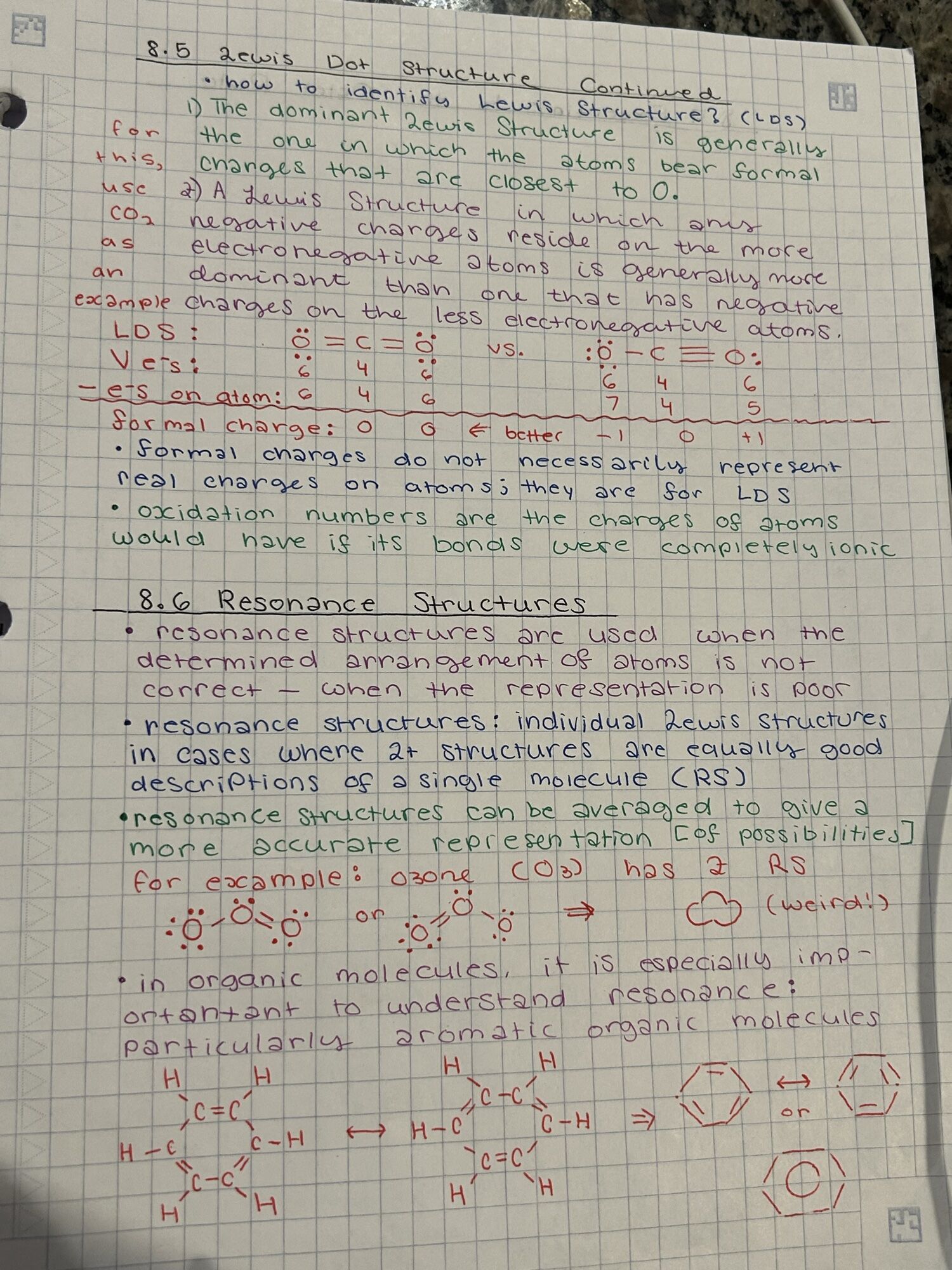
Jaya used CO₂ as the example:
| O=C=O (O) | (C) | (O) | O–C≡O (O, single bond) | (C) | (O, triple bond) | |
|---|---|---|---|---|---|---|
| Valence e⁻ | 6 | 4 | 6 | 6 | 4 | 6 |
| e⁻ assigned to the atom | 6 | 4 | 6 | 7 | 4 | 5 |
| Formal charge | 0 | 0 | 0 | −1 | 0 | +1 |
O=C=O is better: every formal charge is 0.
- Formal charges do not necessarily represent real charges on atoms; they’re for Lewis structures.
- Oxidation numbers are the charges atoms would have if their bonds were completely ionic.
8.6 Resonance Structures
- Resonance structures are used when the determined arrangement of atoms is not correct, when the representation is poor.
- Resonance structures (RS): individual Lewis structures in cases where 2+ structures are equally good descriptions of a single molecule.
- Resonance structures can be averaged to give a more accurate representation of the possibilities.
- For example, ozone (O₃) has 2 resonance structures, O − O = O and O = O − O. The real molecule is a blend of the two (weird!): both O–O bonds are the same length.
- In organic molecules it’s especially important to understand resonance, particularly in aromatic organic molecules such as benzene, C₆H₆. Its two structures have alternating single and double bonds in opposite places, so it’s drawn as a hexagon with a circle inside.
8.7 Exceptions to the Octet Rule
The octet rule has its limitations in ionic compounds of transition metals and in covalent compounds. There are 3 categories:
- Molecules and polyatomic ions containing an odd number of electrons.
- Molecules and polyatomic ions in which an atom has fewer than an octet of valence electrons.
- Molecules and polyatomic ions where atoms have more than an octet.
- In any molecule or ion with an odd number of electrons, there will be an unpaired electron. Where? Based on formal charges.
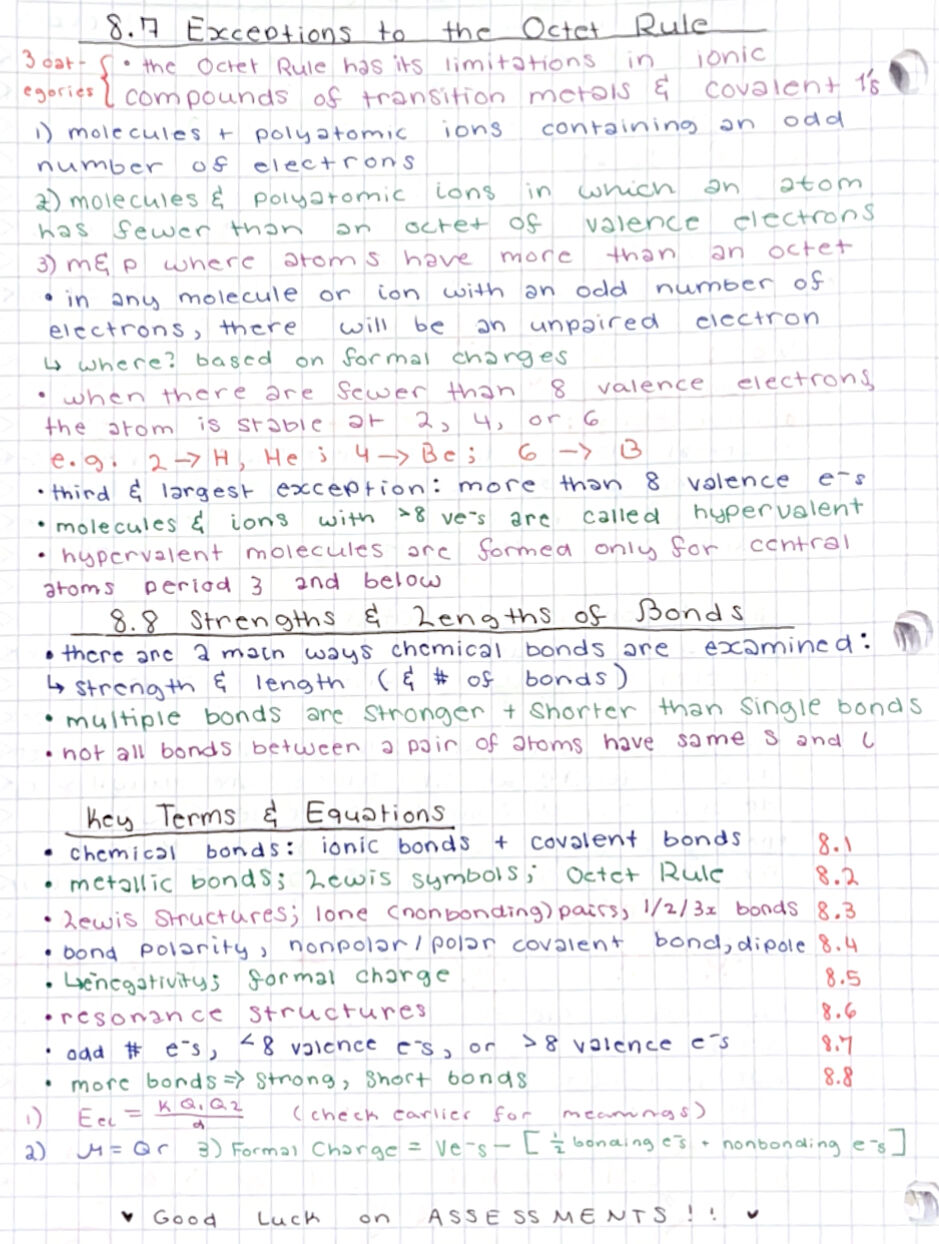
- When there are fewer than 8 valence electrons, the atom is stable at 2, 4, or 6, e.g. 2 → H, He; 4 → Be; 6 → B.
- The third and largest exception: more than 8 valence electrons.
- Molecules and ions with more than 8 valence electrons are called hypervalent.
- Hypervalent molecules are formed only for central atoms in period 3 and below.
8.8 Strengths & Lengths of Bonds
- There are 2 main ways chemical bonds are examined: strength and length (and the number of bonds).
- Multiple bonds are stronger and shorter than single bonds.
- Not all bonds between a pair of atoms have the same strength and length.
Key terms & equations
| Section | Terms |
|---|---|
| 8.1 | chemical bonds: ionic bonds and covalent bonds |
| 8.2 | metallic bonds; Lewis symbols; octet rule |
| 8.3 | Lewis structures; lone (nonbonding) pairs; single, double, triple bonds |
| 8.4 | bond polarity, nonpolar and polar covalent bond, dipole |
| 8.5 | electronegativity; formal charge |
| 8.6 | resonance structures |
| 8.7 | odd number of e⁻, fewer than 8 valence e⁻, or more than 8 valence e⁻ |
| 8.8 | more bonds ⇒ strong, short bonds |
- E_el = κQ₁Q₂/d (see 8.2 for what each symbol means)
- μ = Qr
- Formal charge = valence e⁻ −[1/2(bonding e⁻) + nonbonding e⁻]
Good luck on assessments!
The originals
Jaya's notes as they were shared, before typing up. Select one to see it full size.