Ryan Rezaei's Notes: Chapter 6
(Covered in class)1.5 Atomic Structure and Electron Configuration(Covered in class)3.12 Properties of Photons
A classmate's notes, with the wording kept as close to the original as possible. Where something needed fixing, there's a Correction box right below it. See the original pages.
Practice: Start 10 random questions from Chapter 6 · Pick your own set
On this page 7 sections
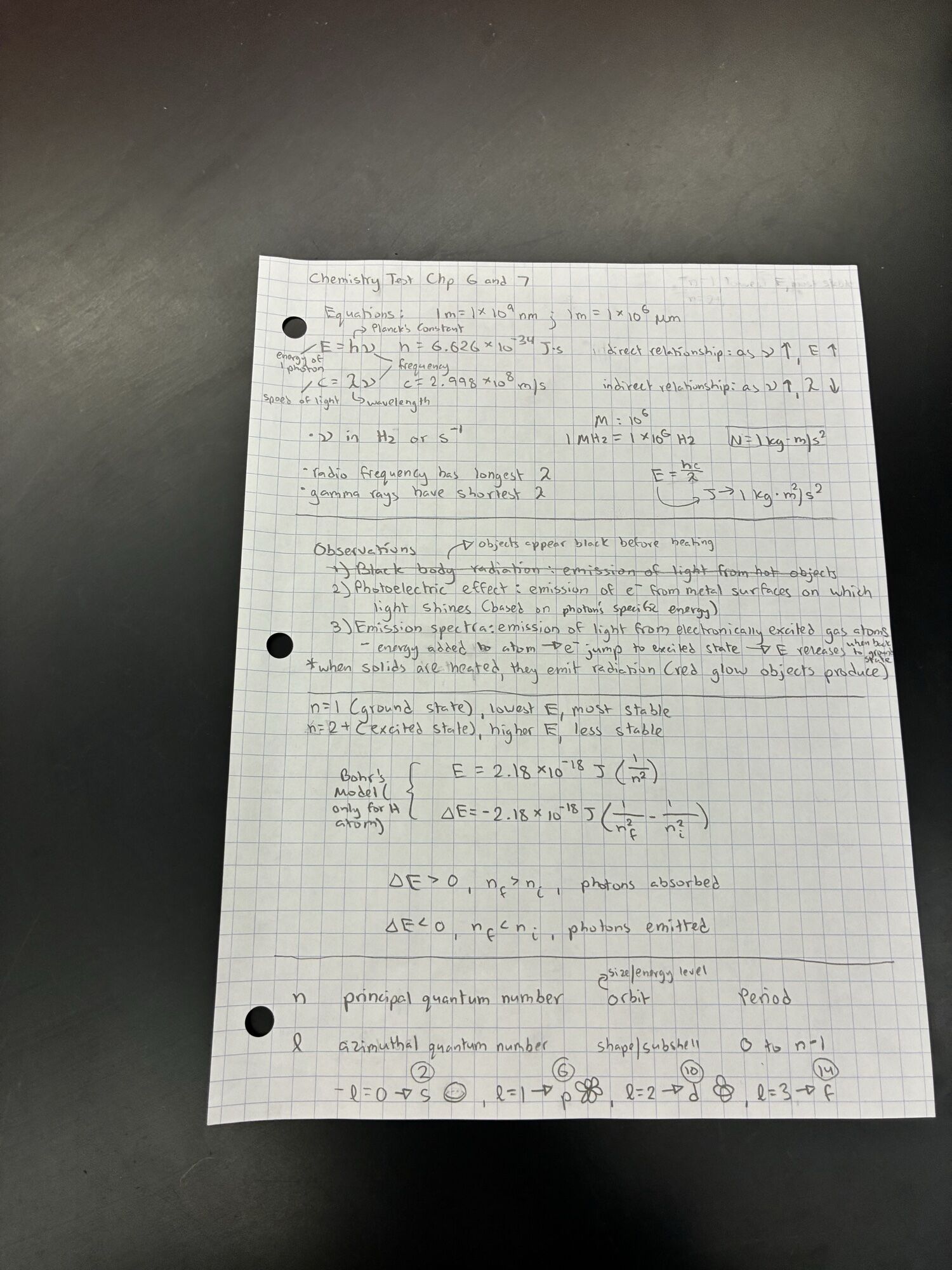
Equations
| Equation | Meaning |
|---|---|
| E = hν | energy of 1 photon; h is Planck’s constant, 6.626 × 10⁻³⁴ J⋅s |
| c = λν | speed of light = wavelength × frequency; c = 2.998 × 10⁸ m/s |
| E = hc/λ | energy of 1 photon from its wavelength |
- Direct relationship: as ν goes up, E goes up.
- Indirect relationship: as ν goes up, λ goes down.
- ν is in Hz or s⁻¹.
Units:
- 1 m = 1 × 10⁹ nm and 1 m = 1 × 10⁶ μm
- M (mega) = 10⁶, so 1 MHz = 1 × 10⁶ Hz
- 1 N = 1 kg⋅m/s² and 1 J = 1 kg⋅m²/s²
Spectrum:
- Radio waves have the longest λ.
- Gamma rays have the shortest λ.
Observations
Blackbody radiation: emission of light from hot objects.(Crossed out in Ryan’s notes.) Objects appear black before heating.- Photoelectric effect: emission of e⁻ from metal surfaces on which light shines (based on the photon’s specific energy).
- Emission spectra: emission of light from electronically excited gas atoms.
- Energy is added to the atom → e⁻ jumps to an excited state → energy is released when it goes back to the ground state.
* When solids are heated, they emit radiation (the red glow hot objects produce).
Definitions
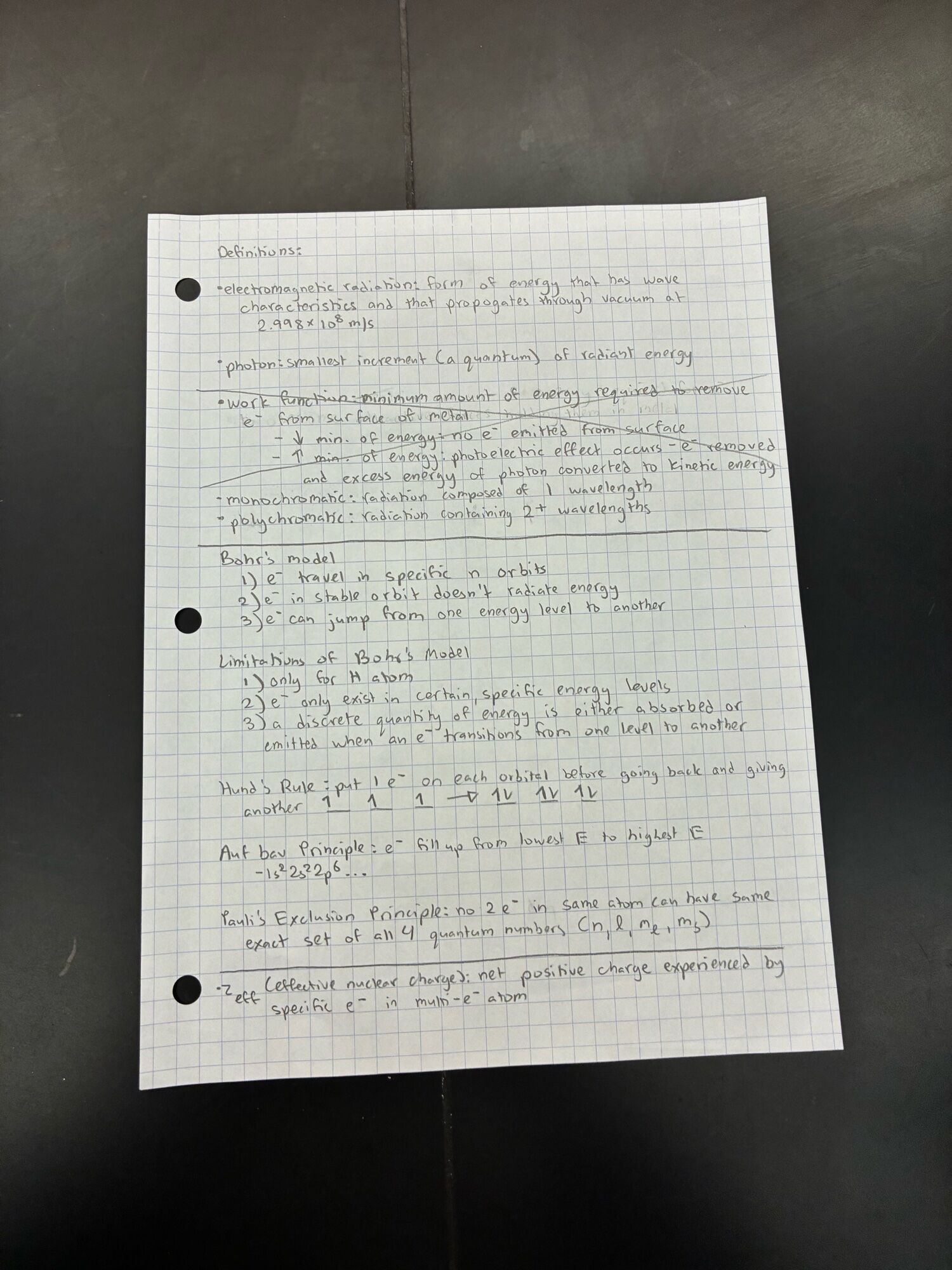
- Electromagnetic radiation: a form of energy that has wave characteristics and propagates through a vacuum at 2.998 × 10⁸ m/s.
- Photon: the smallest increment (a quantum) of radiant energy.
Work function: the minimum amount of energy required to remove an e⁻ from the surface of a metal.(Crossed out in Ryan’s notes.)- Below the minimum energy: no e⁻ emitted from the surface.
- Above the minimum energy: the photoelectric effect occurs. The e⁻ is removed, and the photon’s excess energy is converted to kinetic energy.
- Monochromatic: radiation made of 1 wavelength.
- Polychromatic: radiation containing 2 or more wavelengths.
Bohr’s model (only for the H atom)
- n = 1 (ground state): lowest energy, most stable.
- n = 2 and up (excited state): higher energy, less stable.
- ΔE > 0, n_f > n_i: photons absorbed. (ΔE is positive for absorbance.)
- ΔE < 0, n_f < n_i: photons emitted. (ΔE is negative for emission.)
Bohr’s model:
- e⁻ travel in specific n orbits.
- An e⁻ in a stable orbit doesn’t radiate energy.
- An e⁻ can jump from one energy level to another.
Limitations of Bohr’s model:
- Only works for the H atom.
- e⁻ only exist in certain, specific energy levels.
- A discrete quantity of energy is either absorbed or emitted when an e⁻ transitions from one level to another.
Quantum numbers
| Symbol | Name | Describes | Values |
|---|---|---|---|
| n | principal quantum number | orbit size / energy level; matches the period | 1, 2, 3, … |
| l | azimuthal quantum number | shape / subshell | 0 to n − 1 |
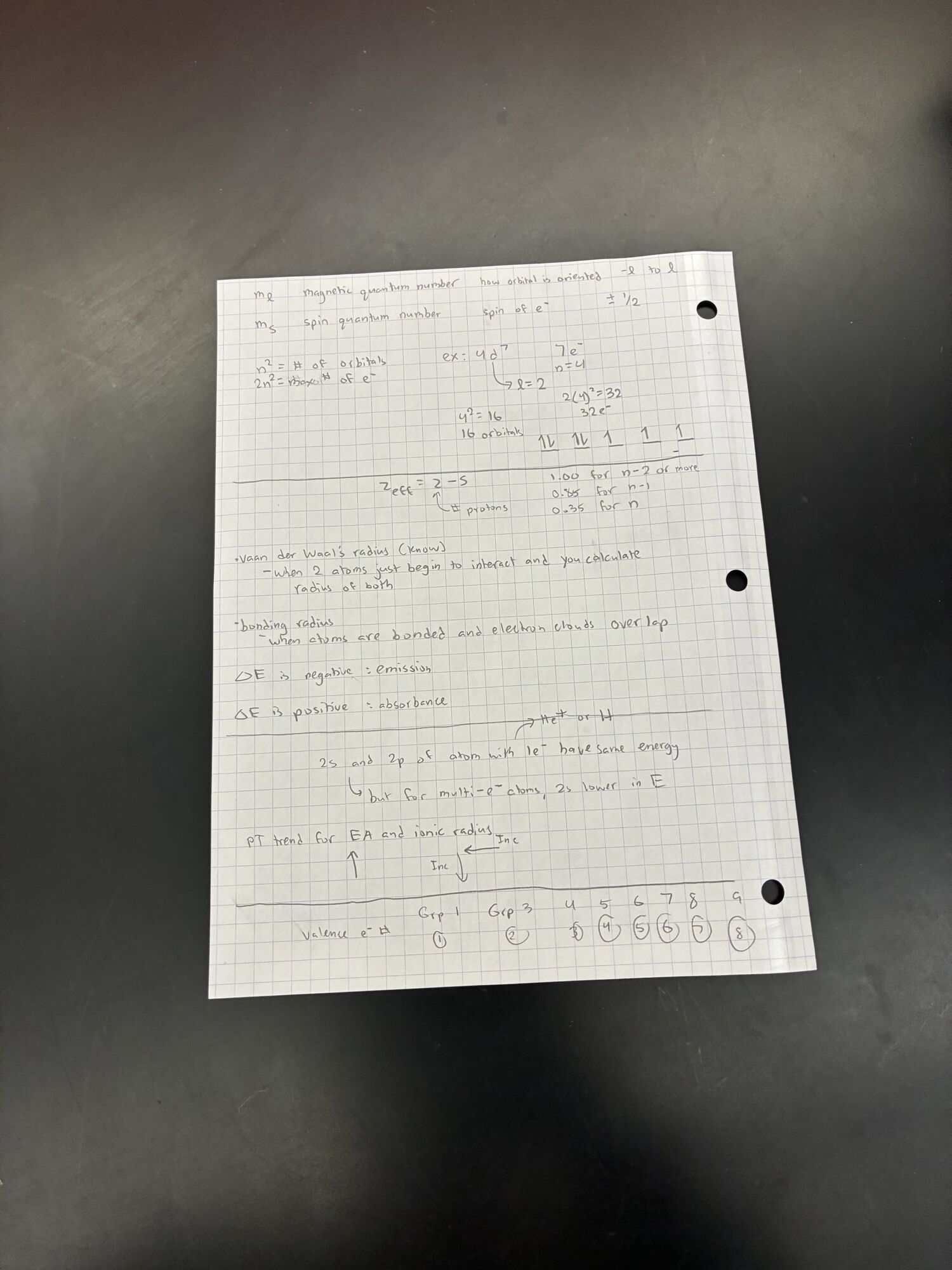
| m_l | magnetic quantum number | how the orbital is oriented | −l to +l |
| m_s | spin quantum number | spin of the e⁻ | ± 1/2 |
| l | 0 | 1 | 2 | 3 |
|---|---|---|---|---|
| Subshell | s (sphere) | p (four-leaf drawing) | d (clover) | f |
| Max e⁻ | 2 | 6 | 10 | 14 |
- n² = number of orbitals
- 2n² = maximum number of e⁻
Example: 4d⁷
- d → l = 2, and n = 4, with 7 e⁻.
- 4² = 16 orbitals in the n = 4 shell, and 2(4)² = 32 e⁻ max.
- Orbital diagram: ↑↓ ↑↓ ↑ ↑ ↑
Orbital energies
The 2s and 2p of an atom with 1 e⁻ (He⁺ or H) have the same energy. But for multi-electron atoms, 2s is lower in energy.
Filling rules
- Hund’s rule: put 1 e⁻ in each orbital before going back and giving another: ↑ ↑ ↑ → ↑↓ ↑↓ ↑↓
- Aufbau principle: e⁻ fill up from lowest energy to highest energy: 1s² 2s² 2p⁶…
- Pauli’s exclusion principle: no 2 e⁻ in the same atom can have the exact same set of all 4 quantum numbers (n, l, m_l, m_s).
The originals
Ryan Rezaei's notes as they were shared, before typing up. Select one to see it full size.