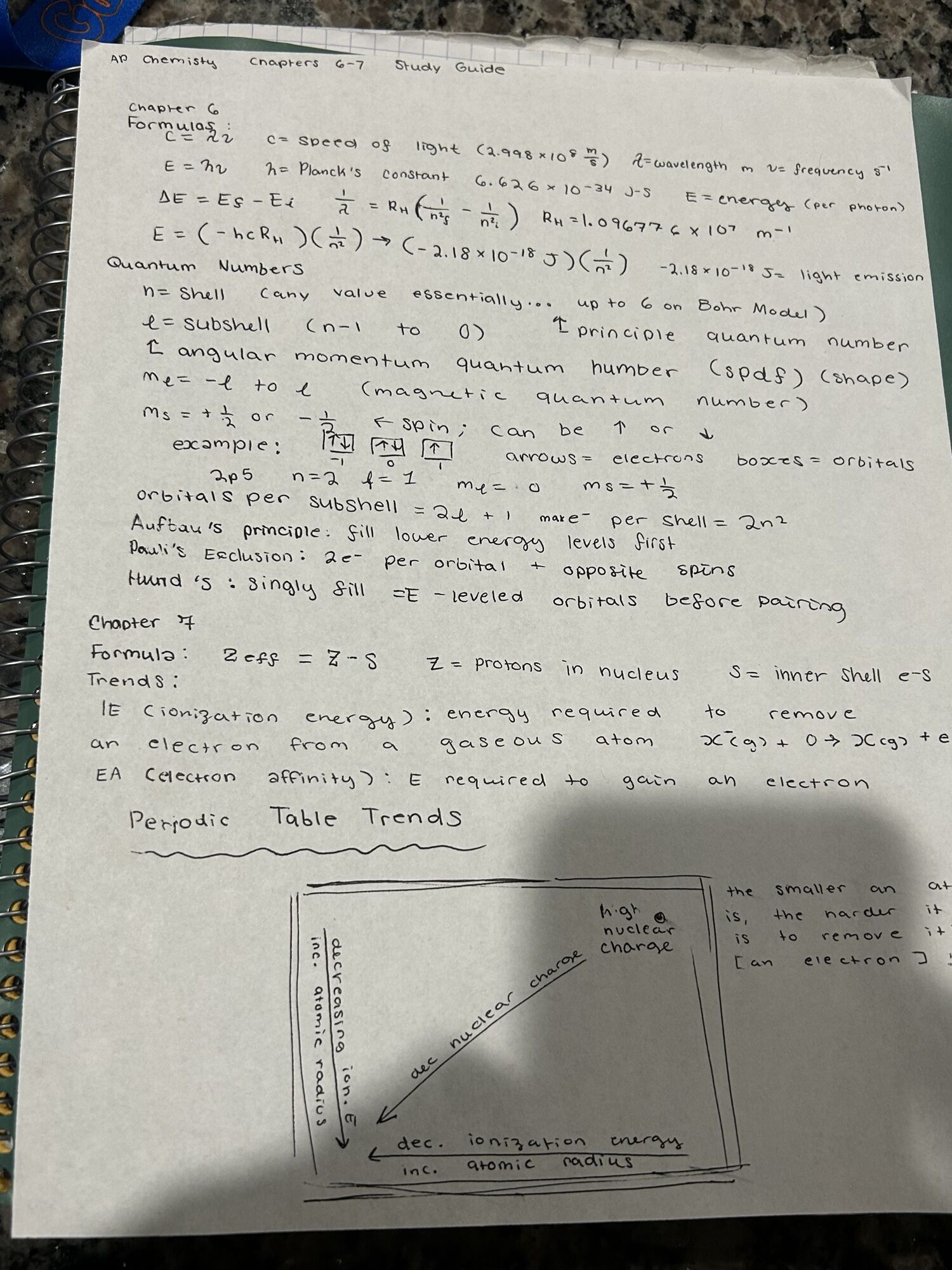
Jaya's Notes: Chapter 6
(Covered in class)1.5 Atomic Structure and Electron Configuration(Covered in class)3.12 Properties of Photons
A classmate's notes, with the wording kept as close to the original as possible. Where something needed fixing, there's a Correction box right below it. See the original pages.
Practice: Start 10 random questions from Chapter 6 · Pick your own set
On this page 3 sections
Formulas
| Formula | Symbols |
|---|---|
| c = λν | c = speed of light (2.998 × 10⁸ m/s), λ = wavelength (m), ν = frequency (s⁻¹) |
| E = hν | h = Planck’s constant (6.626 × 10⁻³⁴ J·s), E = energy (per photon) |
| ΔE = E_f − E_i | change in energy between two levels |
| 1/λ = R_H(1/(n_f²) − 1/(n_i²)) | R_H = 1.096776 × 10⁷ m⁻¹ (Rydberg constant) |
| E = (−hcR_H)(1/n²) = (−2.18 × 10⁻¹⁸ J)(1/n²) | energy of level n |
Jaya’s note: ”−2.18 × 10⁻¹⁸ J = light emission.”
Quantum numbers
- n = shell, the principal quantum number. It can be essentially any value (up to 6 on the Bohr model).
- l = subshell, the angular momentum quantum number (s, p, d, f), which gives the shape. Values from n − 1 down to 0.
- m_l = −l to +l, the magnetic quantum number.
- m_s = +1/2 or −1/2, the spin. It can be ↑ or ↓.
Example: 2p⁵. Arrows are electrons and boxes are orbitals:
| m_l = −1 | m_l = 0 | m_l = +1 |
|---|---|---|
| ↑↓ | ↑↓ | ↑ |
Jaya’s notes list the last electron as n = 2, l = 1, m_l = 0, m_s = +1/2.
- Orbitals per subshell = 2l + 1
- Max e⁻ per shell = 2n²
Filling rules
- Aufbau’s principle: fill lower energy levels first.
- Pauli’s exclusion: 2 e⁻ per orbital, with opposite spins.
- Hund’s rule: singly fill equal-energy orbitals before pairing.
The originals
Jaya's notes as they were shared, before typing up. Select one to see it full size.