Sophia T's Notes: Chapter 6
(Covered in class)1.5 Atomic Structure and Electron Configuration(Covered in class)3.12 Properties of Photons
A classmate's notes, with the wording kept as close to the original as possible. Where something needed fixing, there's a Correction box right below it. See the original pages.
Practice: Start 10 random questions from Chapter 6 · Pick your own set
On this page 8 sections
Ch 6 theory
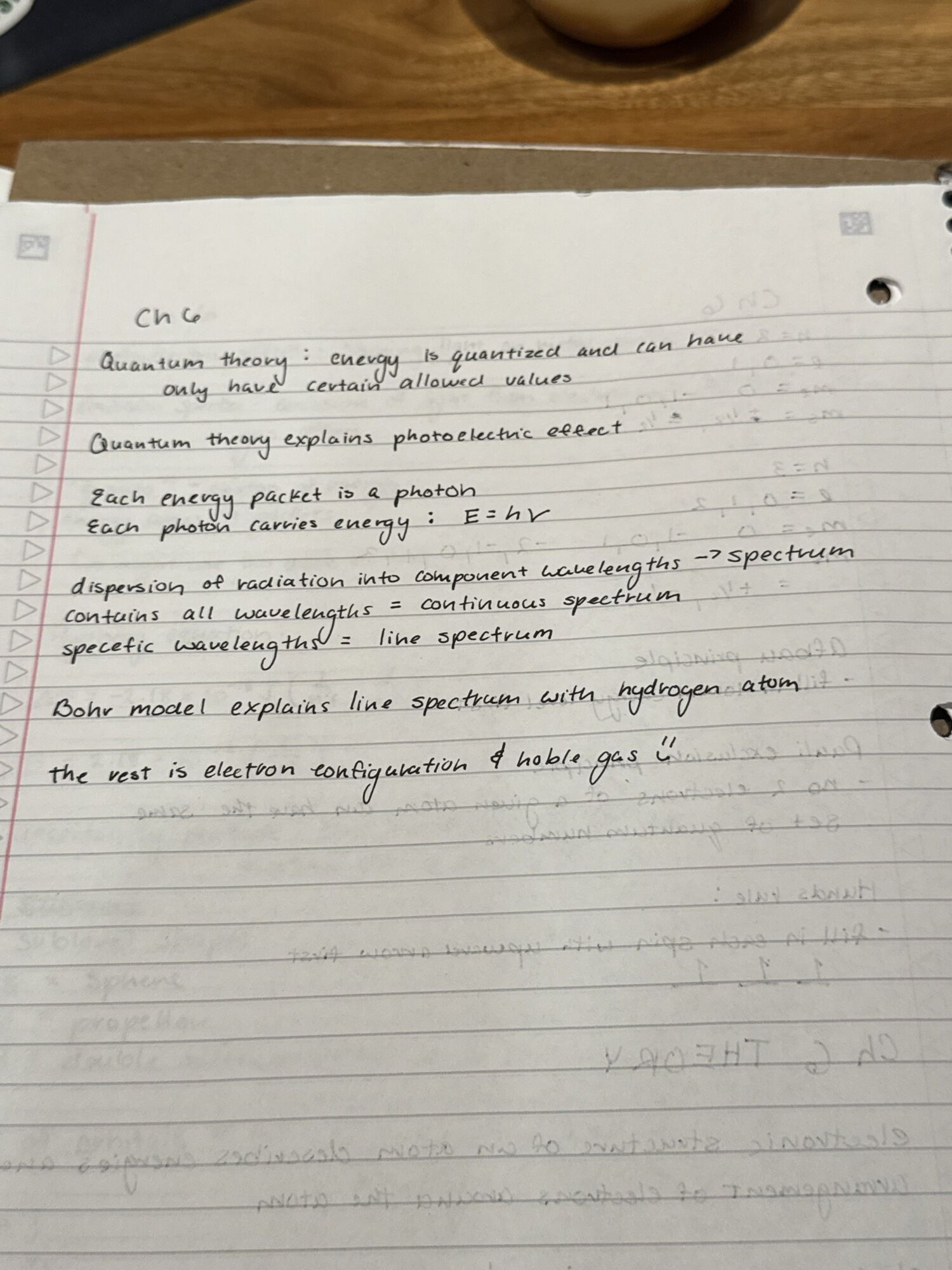
- The electronic structure of an atom describes the energies and arrangement of electrons around the atom.
- Electromagnetic radiation and visible light move through a vacuum at the speed of light.
- Quantum theory: energy is quantized and can only have certain allowed values.
- Quantum theory explains the photoelectric effect.
- Each energy packet is a photon. Each photon carries energy E = hν.
- Dispersion of radiation into its component wavelengths gives a spectrum.
- Contains all wavelengths = continuous spectrum
- Specific wavelengths only = line spectrum
- The Bohr model explains the line spectrum of the hydrogen atom.
- The rest is electron configurations and noble-gas configurations.
Vocabulary
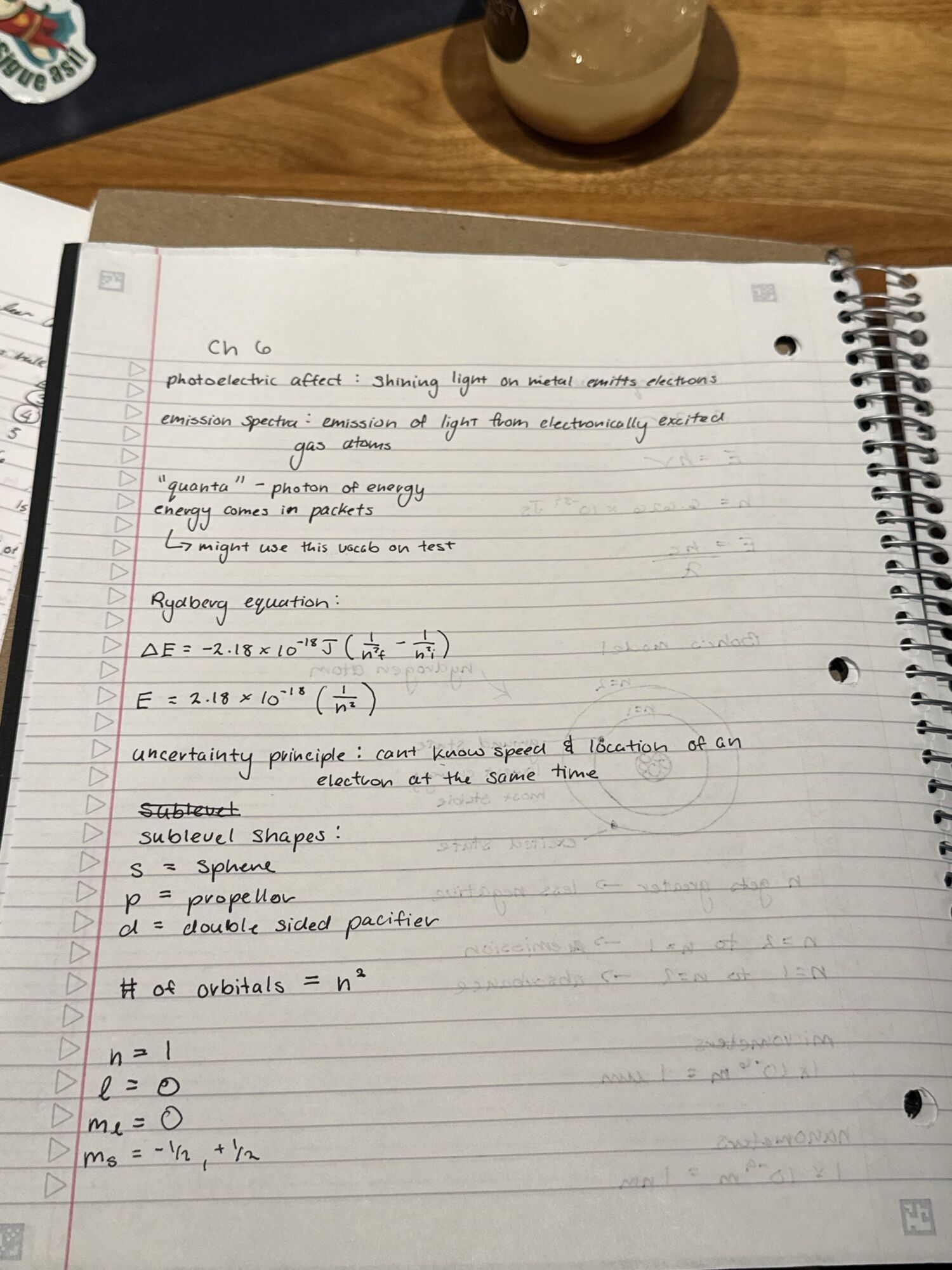
- Photoelectric effect: shining light on a metal emits electrons.
- Emission spectra: emission of light from electronically excited gas atoms.
- “Quanta”: a photon of energy. Energy comes in packets. (Might use this vocab on the test.)
- Uncertainty principle: you can’t know the speed and location of an electron at the same time.
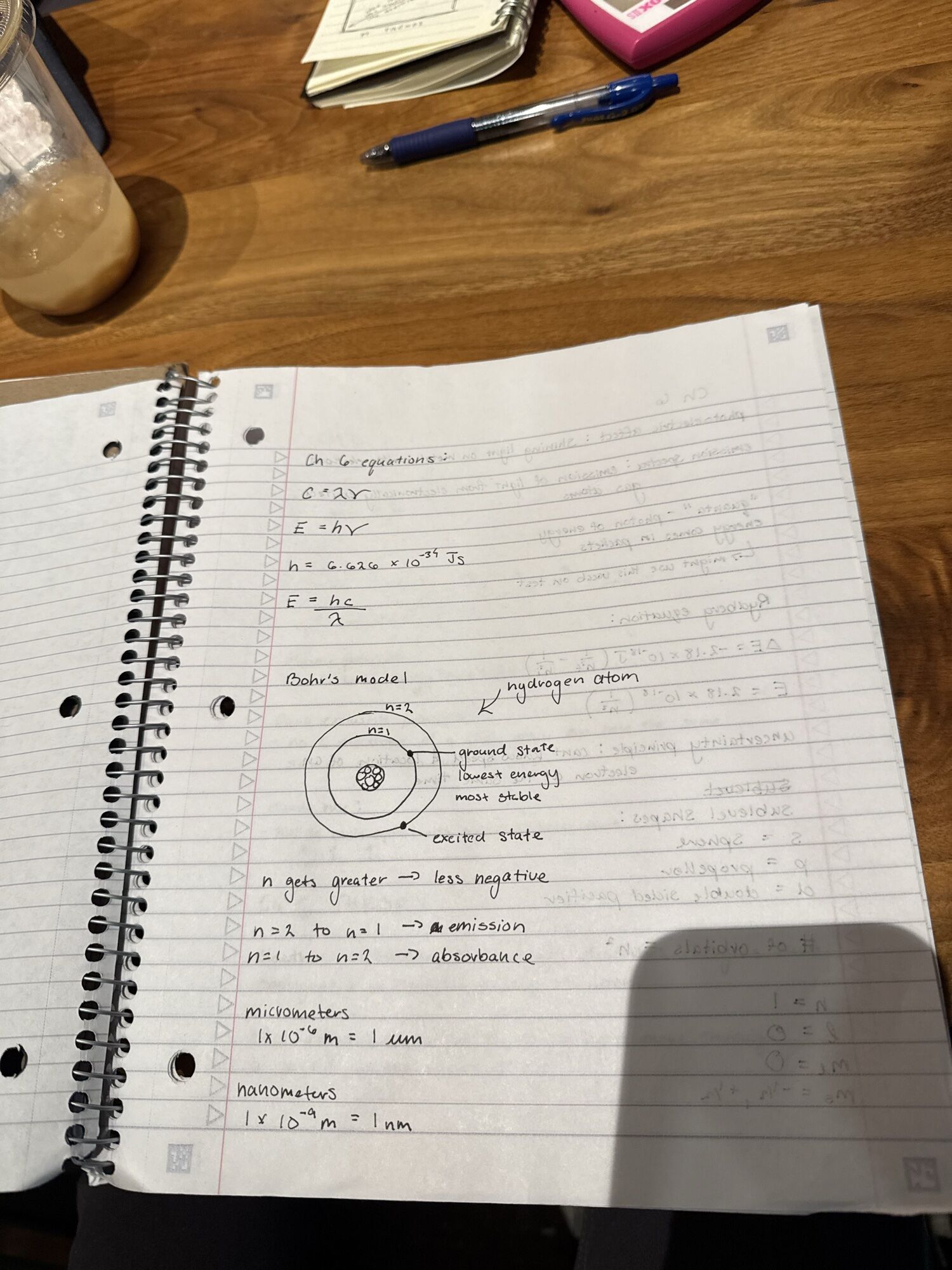
Ch 6 equations
c = λν E = hν E = hc/λ h = 6.626 × 10⁻³⁴ J⋅sUnits:
- Micrometers: 1 × 10⁻⁶ m = 1 μm
- Nanometers: 1 × 10⁻⁹ m = 1 nm
Rydberg (Bohr) equations
ΔE = −2.18 × 10⁻¹⁸ J(1/(n_f²) − 1/(n_i²)) E = 2.18 × 10⁻¹⁸(1/n²)Bohr’s model (hydrogen atom)
Sophia’s drawing shows the nucleus with two rings, n = 1 and n = 2:
- An electron on n = 1 is in the ground state: lowest energy, most stable.
- An electron on n = 2 is in an excited state.
- As n gets greater, the energy gets less negative.
- n = 2 to n = 1 → emission
- n = 1 to n = 2 → absorbance (absorption)
Sublevel shapes
| Sublevel | Shape |
|---|---|
| s | sphere |
| p | propeller |
| d | double-sided pacifier |
Number of orbitals in a shell = n².
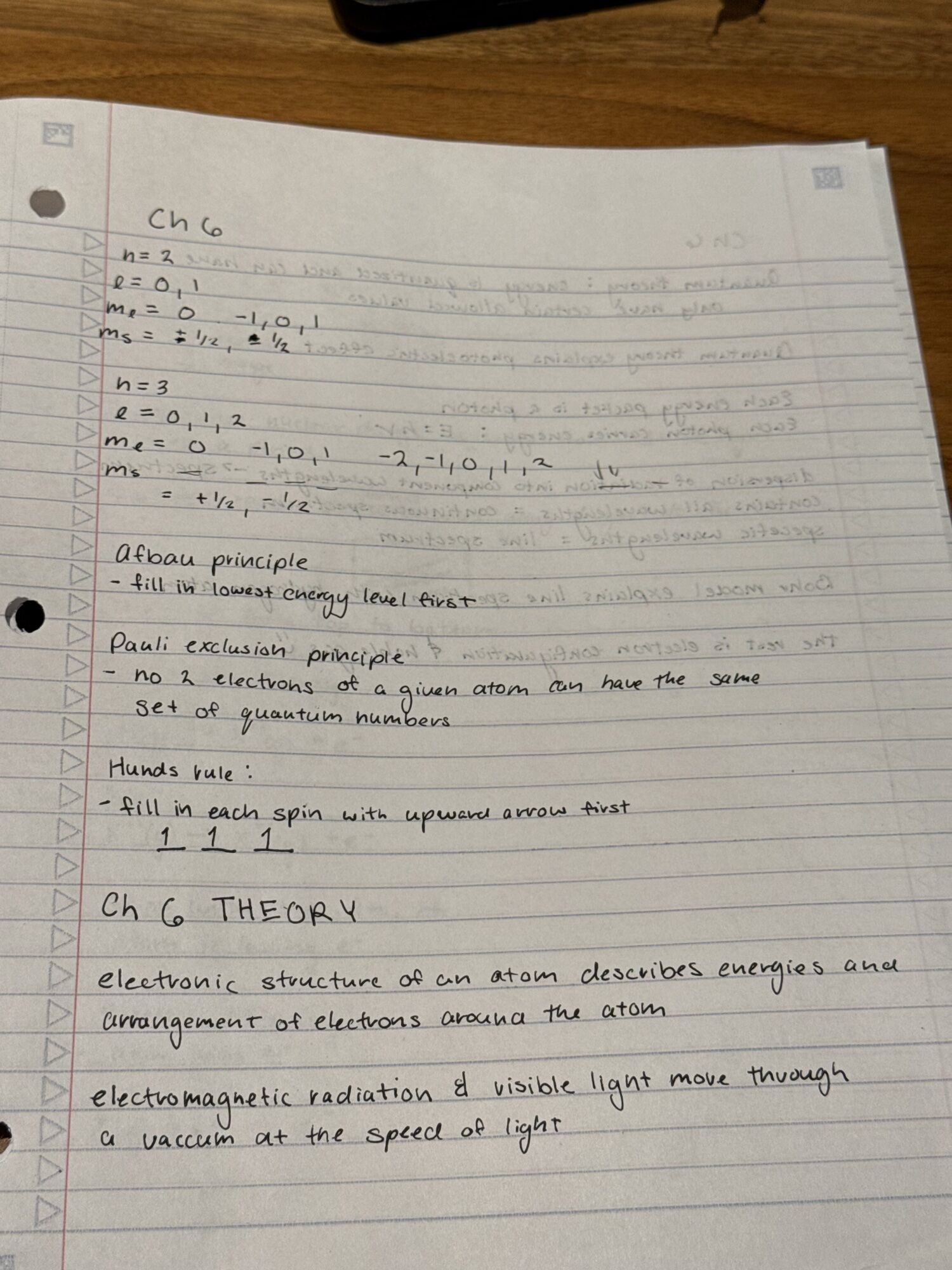
Quantum numbers by shell
| Quantum number | n = 1 | n = 2 | n = 3 |
|---|---|---|---|
| l | 0 | 0, 1 | 0, 1, 2 |
| m_l | 0 | 0 / −1, 0, 1 | 0 / −1, 0, 1 / −2, −1, 0, 1, 2 |
| m_s | −1/2,+1/2 | +1/2,−1/2 | +1/2,−1/2 |
Filling rules
- Aufbau principle: fill in the lowest energy level first.
- Pauli exclusion principle: no 2 electrons of a given atom can have the same set of quantum numbers.
- Hund’s rule: fill in each orbital with an upward arrow first: ↑ ↑ ↑
The originals
Sophia T's notes as they were shared, before typing up. Select one to see it full size.