Sophia T's Notes: Chapter 7
A classmate's notes, with the wording kept as close to the original as possible. Where something needed fixing, there's a Correction box right below it. See the original pages.
Practice: Start 10 random questions from Chapter 7 · Pick your own set
On this page 5 sections
Effective nuclear charge
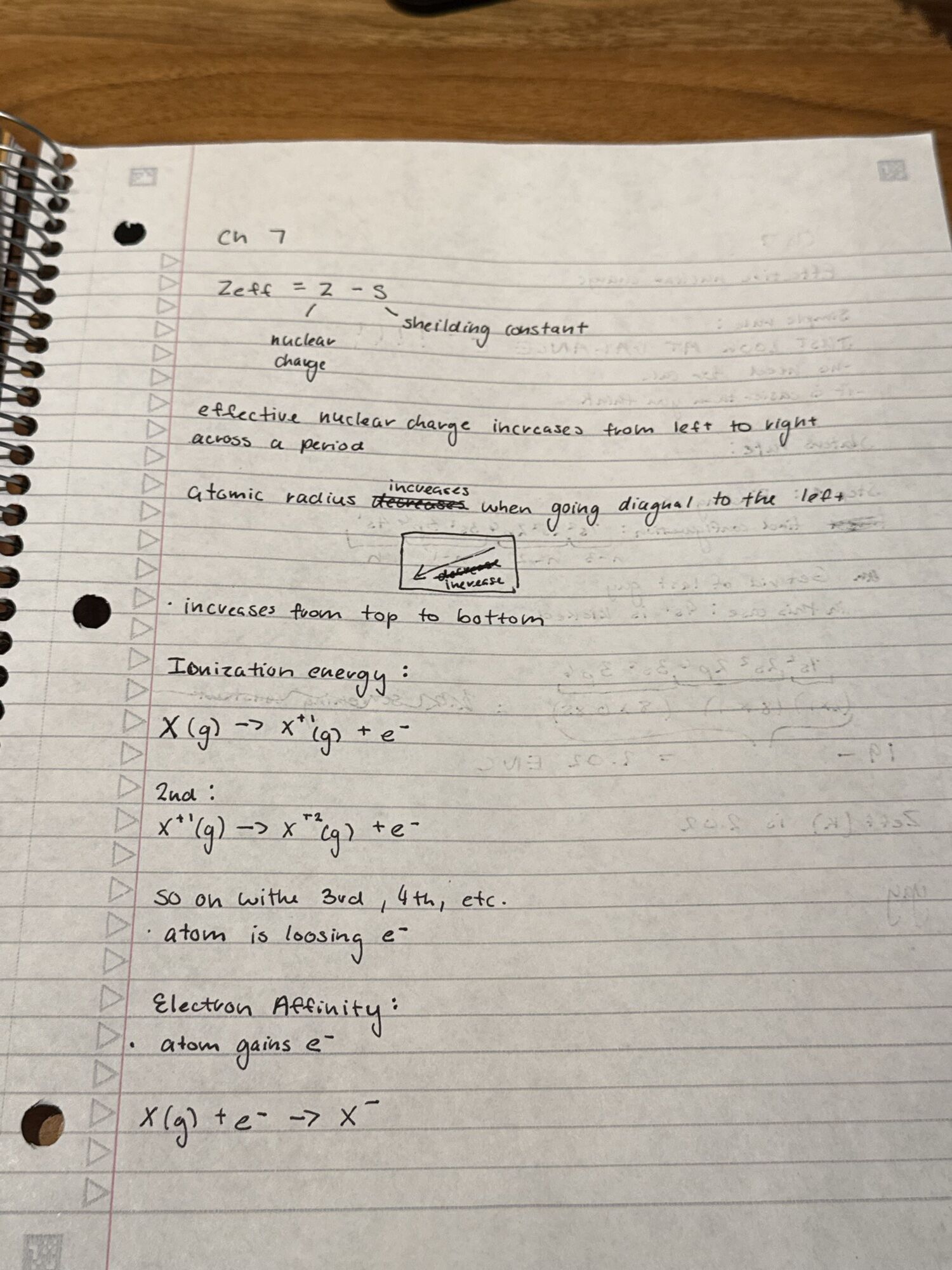
Z_eff = Z − S- Z = nuclear charge
- S = shielding constant
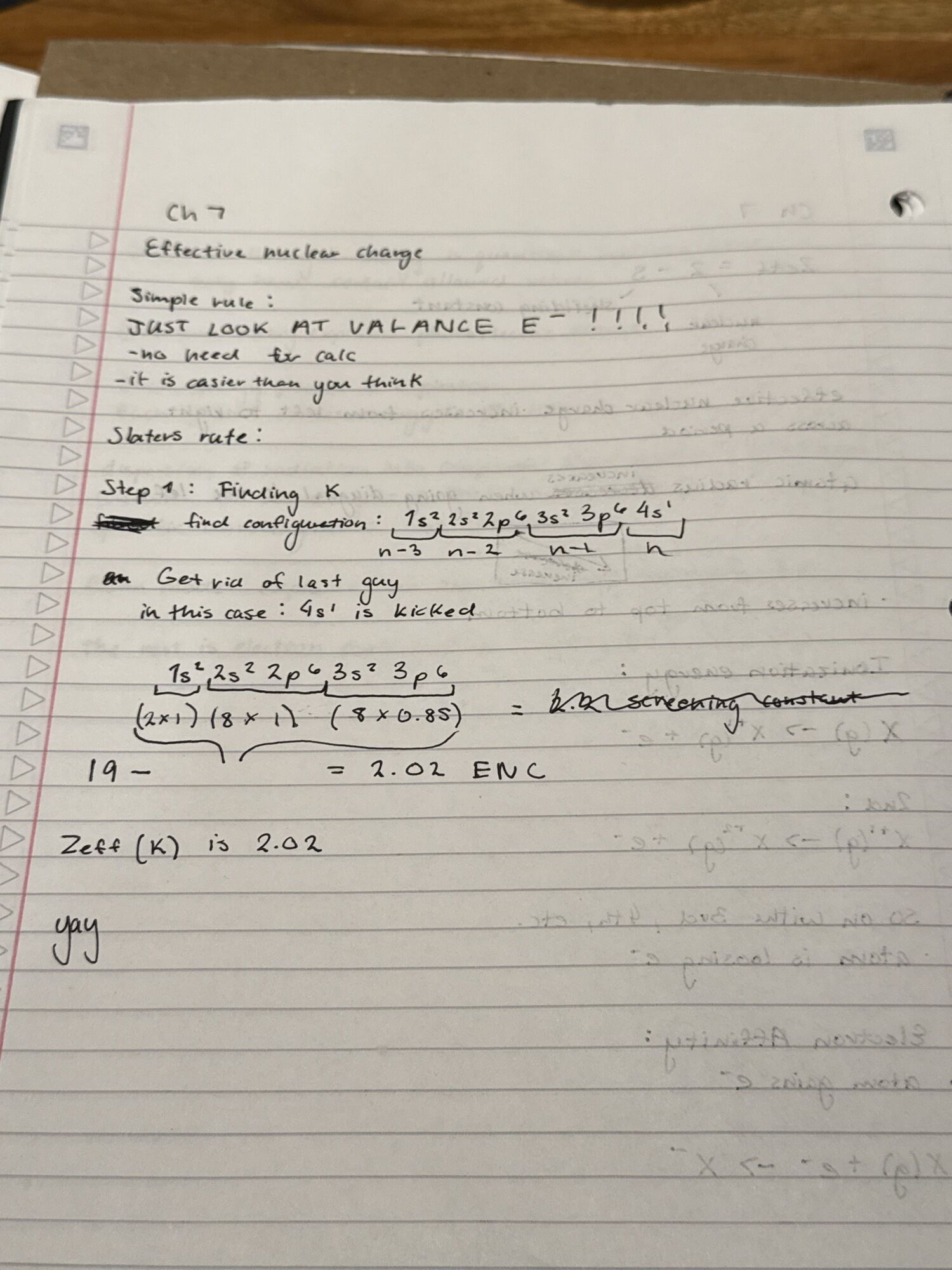
Simple rule: JUST LOOK AT VALENCE e⁻!!! No need for a calculation. It is easier than you think.
Slater’s rules: finding Zeff for K
Step 1: find the configuration and group it by shell:
| 1s² | 2s² 2p⁶ | 3s² 3p⁶ | 4s¹ |
|---|---|---|---|
| n − 3 | n − 2 | n − 1 | n |
Step 2: get rid of the last guy. In this case 4s¹ is kicked out, because it’s the electron we’re finding Zeff for.
Step 3: multiply each group by its shielding value and subtract from Z:
19 − [(2 × 1) + (8 × 1) + (8 × 0.85)]Sophia’s notes give the answer as Z_eff(K) = 2.02.
Trends
- Effective nuclear charge increases from left to right across a period.
- Atomic radius increases going diagonally to the left (down and to the left).
- It increases from top to bottom.
Ionization energy
X(g) → X⁺(g) + e⁻2nd:
X⁺(g) → X²⁺(g) + e⁻And so on with the 3rd, 4th, and so on. The atom is losing an electron.
Electron affinity
The atom gains an electron:
X(g) + e⁻ → X⁻(g)The originals
Sophia T's notes as they were shared, before typing up. Select one to see it full size.