Ryan Rezaei's Notes: Chapter 7
A classmate's notes, with the wording kept as close to the original as possible. Where something needed fixing, there's a Correction box right below it. See the original pages.
Practice: Start 10 random questions from Chapter 7 · Pick your own set
On this page 7 sections
Effective nuclear charge
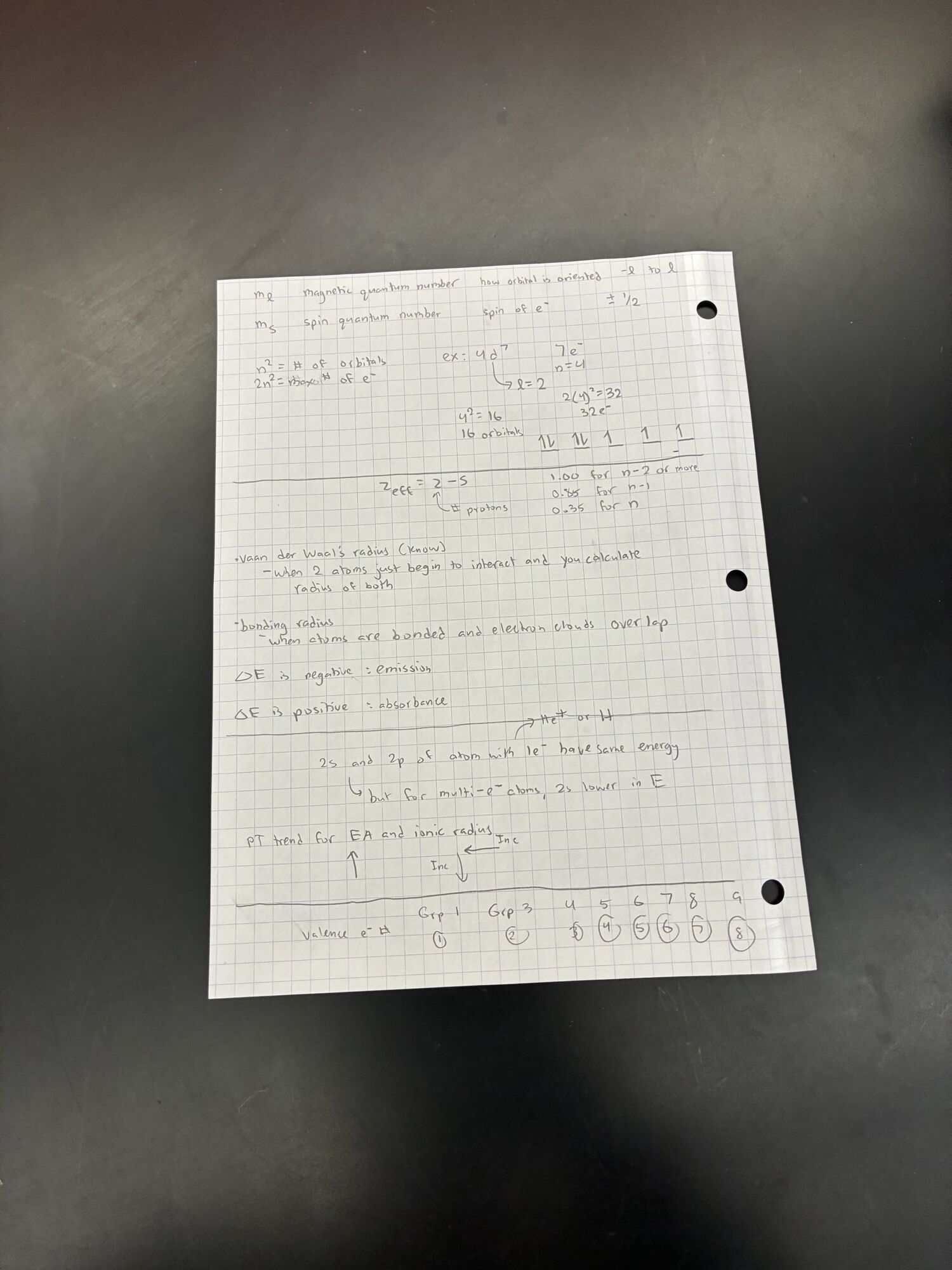
Zeff (effective nuclear charge): the net positive charge experienced by a specific e⁻ in a multi-electron atom.
Z_eff = Z − S (Z = number of protons)Slater’s shielding values:
| Electrons in… | Each counts |
|---|---|
| n − 2 or lower | 1.00 |
| n − 1 | 0.85 |
| n (same shell) | 0.35 |
Radius definitions
- Van der Waals radius (know this): when 2 atoms just begin to interact, and you calculate the radius of both.
- Bonding radius: when atoms are bonded and their electron clouds overlap.
Ionization energy
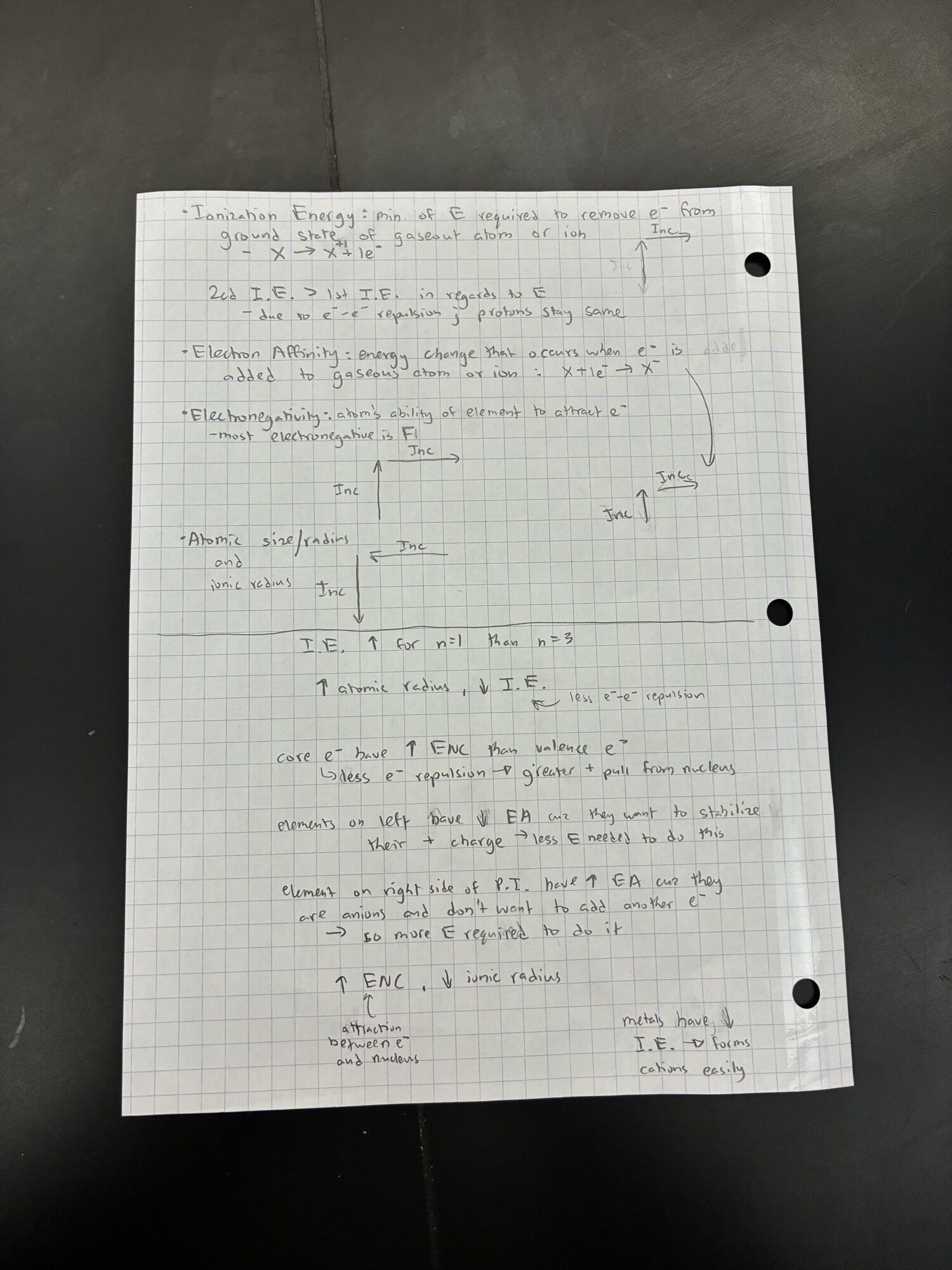
Ionization energy: the minimum energy required to remove an e⁻ from the ground state of a gaseous atom or ion.
X → X⁺ + 1 e⁻The 2nd I.E. is greater than the 1st I.E. in terms of energy, due to e⁻–e⁻ repulsion; the protons stay the same.
- I.E. is higher for an n = 1 electron than for an n = 3 electron.
- Larger atomic radius → lower I.E. (Ryan’s note: “less e⁻–e⁻ repulsion”)
- Core e⁻ feel a higher ENC (Zeff) than valence e⁻: less e⁻ repulsion → a greater + pull from the nucleus.
- Metals have low I.E., so they form cations easily.
Electron affinity
Electron affinity: the energy change that occurs when an e⁻ is added to a gaseous atom or ion.
X + 1 e⁻ → X⁻- Elements on the left have lower EA, because they want to stabilize their + charge, so less energy is needed to do this.
- Elements on the right side of the P.T. have higher EA, because they are anions and don’t want to add another e⁻, so more energy is required to do it.
Electronegativity
Electronegativity: an atom’s ability to attract e⁻. The most electronegative element is F.
Trend arrows
| Property | Increases going… |
|---|---|
| Ionization energy | right and up |
| Electron affinity | right and up |
| Electronegativity | right and up |
| Atomic size / radius and ionic radius | left and down |
- Higher ENC (the attraction between e⁻ and the nucleus) → smaller ionic radius.
Valence electrons
Ryan’s notes count valence electrons across the main-group columns:
| Group | 1 | 2 | 13 | 14 | 15 | 16 | 17 | 18 |
|---|---|---|---|---|---|---|---|---|
| Valence e⁻ | 1 | 2 | 3 | 4 | 5 | 6 | 7 | 8 |
The originals
Ryan Rezaei's notes as they were shared, before typing up. Select one to see it full size.