Molecular Shape and Polarity
Practice: Start 10 random questions on this lesson · Pick your own set
On this page 3 sections
1. Bond dipoles add like arrows
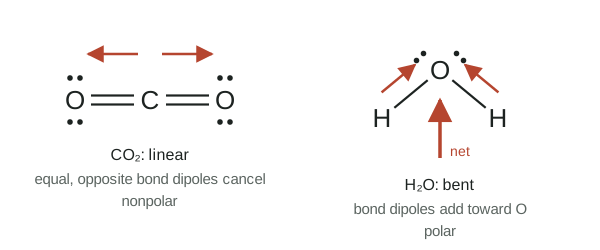
Chapter 8 showed that a bond between atoms of different electronegativity has a bond dipole. A whole molecule’s dipole moment is the sum of its bond dipoles, and because each one has a direction, they add like arrows (vectors), not like plain numbers. Two equal arrows pointing opposite ways add up to zero.
So whether a molecule is polar depends on two things:
- whether it has polar bonds, and
- its shape, which decides whether those bond dipoles cancel.
| Molecule | Shape | Bond dipoles | Overall |
|---|---|---|---|
| CO₂ | linear | the two C=O dipoles point in opposite directions and cancel | nonpolar |
| H₂O | bent | both O–H dipoles point partly toward O, so they add | polar |
| BF₃ | trigonal planar | three equal dipoles 120° apart cancel | nonpolar |
| NH₃ | trigonal pyramidal | the three N–H dipoles all tilt toward N | polar |
| CCl₄ | tetrahedral | four equal dipoles cancel | nonpolar |
| CHCl₃ | tetrahedral | C–H and C–Cl dipoles are different, so they don’t cancel | polar |
CO₂ and H₂O are the classic pair: both have two polar bonds, but only the bent one is polar.
2. A quick check
A molecule is nonpolar if either is true:
- all its bonds are nonpolar (like Cl₂ or the C–C and C–H framework of hydrocarbons, which are treated as nonpolar), or
- the central atom is surrounded symmetrically: all the outer atoms are the same, and there are no lone pairs on the central atom, or the lone pairs are arranged symmetrically (opposite each other, or evenly spaced around the middle).
The second case covers the basic shapes (linear, trigonal planar, tetrahedral, trigonal bipyramidal, octahedral) with identical outer atoms, plus two shapes that do have lone pairs:
- XeF₂, linear: three equatorial lone pairs, and the two F atoms are opposite each other.
- XeF₄, square planar: the two lone pairs are opposite each other, and so are each pair of F atoms.
Turn XeF₄ to see that every Xe–F bond has a partner pointing the opposite way:
XeF₄
- Electron-domain geometry
- octahedral
- Molecular geometry
- square planar
The purple lobes are lone pairs. They count as electron domains but aren't part of the molecular geometry.
- xenon
- fluorine
Everything else with polar bonds is usually polar: bent, trigonal pyramidal, seesaw, T-shaped, square pyramidal, and most shapes where the outer atoms aren’t all the same. When the outer atoms differ, check whether each bond dipole has an equal partner pointing the opposite way.
CH₂Cl₂ is tetrahedral, but the two Cl atoms are on one side of the carbon and the two H atoms on the other, so the bond dipoles can’t cancel:
CH₂Cl₂
- Electron-domain geometry
- tetrahedral
- Molecular geometry
- tetrahedral
No lone pairs on the central atom, so both geometries are the same.
- carbon
- hydrogen
- chlorine
Worked example: polar or nonpolar?
| Molecule | Shape | Polar? | Why |
|---|---|---|---|
| SO₂ | bent (3 domains, 1 lone pair) | polar | the lone pair breaks the symmetry |
| SO₃ | trigonal planar | nonpolar | three identical S–O directions 120° apart |
| CH₂Cl₂ | tetrahedral | polar | two kinds of outer atoms |
| SF₄ | seesaw | polar | the equatorial lone pair breaks the symmetry |
| PCl₅ | trigonal bipyramidal | nonpolar | identical atoms in a symmetric arrangement |
| BrF₅ | square pyramidal | polar | one lone pair with nothing opposite it |
3. Why it matters
Polarity decides how molecules attract each other. Polar molecules line up their δ+ and δ− ends, which affects boiling points and what dissolves in what. That’s the subject of Chapter 11 (intermolecular forces).